
|
You entered: gas
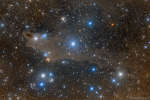 The Shark Nebula
7.09.2015
There is no sea on Earth large enough to contain the Shark nebula. This predator apparition poses us no danger, though, as it is composed only of interstellar gas and dust. Dark dust like that featured here is somewhat like cigarette smoke and created in the cool atmospheres of giant stars.
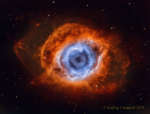 The Helix Nebula in Hydrogen and Oxygen
13.02.2019
Is the Helix Nebula looking at you? No, not in any biological sense, but it does look quite like an eye. The Helix Nebula is so named because it also appears that you are looking down the axis of a helix.
 APOD: 2026 May 20 Б The Dark Wolf Nebula
20.05.2026
A dark wolf lies in gum. No, this isnБt a riddle! Today's image features the Dark Wolf Nebula (SandqvistБLindroos 17), a spooky dust cloud embedded within the Gum 55 (RCW 113) Nebula in the Scorpius constellation.
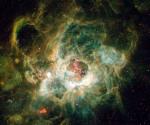 NGC 604: Giant Stellar Nursery
2.11.2002
Scattered within this cavernous nebula, cataloged as NGC 604, are over 200 newly formed hot, massive, stars. At 1,500 light-years across, this expansive cloud of interstellar gas and dust is effectively a giant stellar nursery located some three million light-years distant in the spiral galaxy, M33.
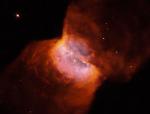 NGC 2346: A Butterfly Shaped Planetary Nebula
12.10.1999
It may look like a butterfly, but it's bigger than our Solar System. NGC 2346 is a planetary nebula made of gas and dust that has evolved into a familiar shape. At the heart of the bipolar planetary nebula is a pair of close stars orbiting each other once every sixteen days.
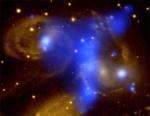 X rays from Stephan s Quintet
12.08.2003
Stephan's Quintet is a picturesque but clearly troubled grouping of galaxies about 300 million light-years away toward the high-flying constellation Pegasus. Spanning over 200,000 light-years at that distance, this composite false-color image...
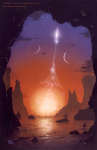 Dawn Before Nova
17.11.2009
Will this dawn bring another nova? Such dilemmas might be pondered one day by future humans living on a planet orbiting a cataclysmic variable binary star system. Cataclysmic variables involve gas falling from a large star onto an accretion disk surrounding a massive but compact white dwarf star.
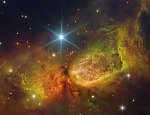 Star Forming Region S106
7.11.2011
Massive star IRS 4 is beginning to spread its wings. Born only about 100,000 years ago, material streaming out from this newborn star has formed the nebula dubbed Sharpless 2-106 Nebula (S106), pictured above.
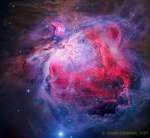 M42: Inside the Orion Nebula
30.10.2019
The Great Nebula in Orion, an immense, nearby starbirth region, is probably the most famous of all astronomical nebulas. Here, glowing gas surrounds hot young stars at the edge of an immense interstellar molecular cloud only 1500 light-years away.
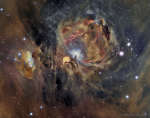 Orion Nebula in Oxygen, Hydrogen, and Sulfur
4.10.2020
Few astronomical sights excite the imagination like the nearby stellar nursery known as the Orion Nebula. The Nebula's glowing gas surrounds hot young stars at the edge of an immense interstellar molecular cloud.
|
January February March April May June July August September October |
|||||||||||||||||||||||||||||||||||||||||||||||||