
|
You entered: gas
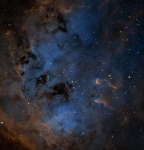 The Tadpoles of IC 410
9.01.2014
This telescopic close-up shows off the otherwise faint emission nebula IC 410 in striking false-colors. It also features two remarkable inhabitants of the cosmic pond of gas and dust below and right of center, the tadpoles of IC 410. The picture is a composite of images taken through narrow band filters.
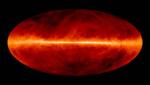 A Sky Full Of Hydrogen
1.03.1998
Interstellar space is filled with extremely tenuous clouds of gas which are mostly Hydrogen. The neutral hydrogen atom (HI in astronomer's shorthand) consists of 1 proton and 1 electron. The proton and electron spin like tops but can have only two orientations; spin axes parallel or anti-parallel.
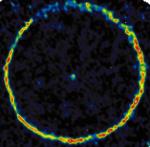 TT Cygni: Carbon Star
18.12.1998
TT Cygni is a cool red giant star with a wind. This false-color picture of TT Cyg was made using a coordinated array of millimeter wavelength radio telescopes and shows radio emission from carbon monoxide (CO) molecules in the surrounding gas.
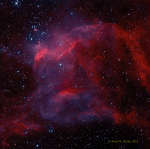 NGC 3572 and the Southern Tadpoles
8.11.2019
This cosmic skyscape features glowing gas and dark dust clouds along side the young stars of NGC 3572. A beautiful emission nebula and star cluster in far southern skies, the region is often overlooked by astroimagers in favor of its brighter neighbor, the nearby Carina Nebula.
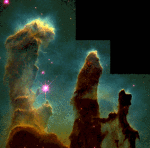 M16: Stars Upon Pillars
6.11.1995
How do stars form? This stunning picture taken recently by the Hubble Space Telescope gives us a first hand glimpse. Here evaporating gaseous globules (EGGs) are captured emerging from pillars of molecular hydrogen and dust in the Eagle Nebula (M16).
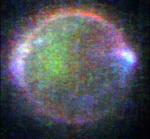 Io Aurora
16.10.1998
Alluring aurora surrounding Io (eye-oh) appear as a ghostly glow while the volcanic moon orbits within Jupiter's dark shadow. Gas giant Jupiter is off to the right of this image, recorded in May by the robot Galileo spacecraft's solid state imaging camera from a distance of about 1.3 million kilometers.
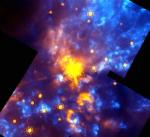 The Heart Of Orion
6.05.2000
Newborn stars lie at at the heart of the the Orion Nebula, hidden from view by the dust and gas of the giant Orion Molecular Cloud number 1 (OMC-1). Sensitive to invisible infrared...
 Planetary Nebula Mz3: The Ant Nebula
25.04.2010
Why isn't this ant a big sphere? Planetary nebula Mz3 is being cast off by a star similar to our Sun that is, surely, round. Why then would the gas that is streaming away create an ant-shaped nebula that is distinctly not round?
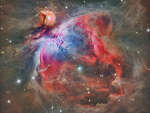 M42: Inside the Orion Nebula
20.03.2013
The Great Nebula in Orion, an immense, nearby starbirth region, is probably the most famous of all astronomical nebulas. Here, glowing gas surrounds hot young stars at the edge of an immense interstellar molecular cloud only 1500 light-years away.
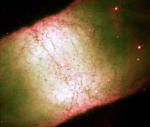 IC 4406: A Seemingly Square Nebula
16.04.2000
How can a round star make a square nebula? This conundrum came to light with the discovery of planetary nebulae like IC 4406. IC 4406 is most probably cylindrical, with its square appearance the result of our vantage point in viewing the cylinder.
|
January February March April May June July August September October |
|||||||||||||||||||||||||||||||||||||||||||||||||