
|
You entered: gas
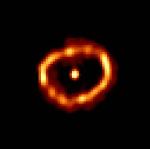 Nova Cygni 1992
27.12.1995
In 1992 a tremendous explosion occurred in the constellation of Cygnus. Dubbed Nova Cygni 1992, this event most probably occurred in an accretion disk binary system. Astronomers hypothesize that this system's white dwarf had so much gas dumped onto it's surface that conditions became ripe for nuclear fusion.
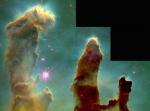 M16: Stars from Eagle's EGGs
25.11.2001
Newborn stars are forming in the Eagle Nebula. This image, taken with the Hubble Space Telescope in 1995, shows evaporating gaseous globules (EGGs) emerging from pillars of molecular hydrogen gas and dust. The giant pillars are light years in length and are so dense that interior gas contracts gravitationally to form stars.
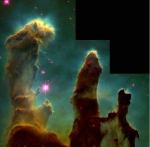 M16: Stars from Eagle's Eggs
24.09.2000
Newborn stars are forming in the Eagle Nebula. This image, taken with the Hubble Space Telescope in 1995, shows evaporating gaseous globules (EGGs) emerging from pillars of molecular hydrogen gas and dust. The giant pillars are light years in length and are so dense that
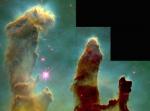 M16: Stars from Eagles EGGs
26.10.2003
Newborn stars are forming in the Eagle Nebula. This image, taken with the Hubble Space Telescope in 1995, shows evaporating gaseous globules (EGGs) emerging from pillars of molecular hydrogen gas and dust. The giant pillars are light years in length and are so dense that interior gas contracts gravitationally to form stars.
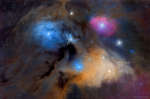 The Colorful Clouds of Rho Ophiuchi
14.10.2020
The many spectacular colors of the Rho Ophiuchi (oh'-fee-yu-kee) clouds highlight the many processes that occur there. The blue regions shine primarily by reflected light. Blue light from the Rho Ophiuchi star system and nearby stars reflects more efficiently off this portion of the nebula than red light.
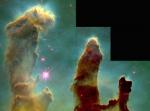 M16: Stars from Eagle's EGGs
24.04.2005
Newborn stars are forming in the Eagle Nebula. This image, taken with the Hubble Space Telescope in 1995, shows evaporating gaseous globules (EGGs) emerging from pillars of molecular hydrogen gas and dust. The giant pillars are light years in length and are so dense that interior gas contracts gravitationally to form stars.
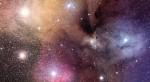 The Colorful Clouds of Rho Ophiuchi
9.07.2005
The many spectacular colors of the Rho Ophiuchi (oh'-fee-yu-kee) clouds highlight the many processes that occur there. The blue regions shine primarily by reflected light. Blue light from the star Rho Ophiuchi and nearby stars reflects more efficiently off this portion of the nebula than red light.
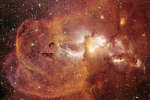 Star Forming Region NGC 3582
28.04.2008
What's happening in the NGC 3582 nebula? Bright stars and interesting molecules are forming. The complex nebula resides in the star forming region called RCW 57. Visible in this image are dense knots...
 APOD: 2025 April 28 Б Gum 37 and the Southern Tadpoles
28.04.2025
This cosmic skyscape features glowing gas and dark dust clouds alongside the young stars of NGC 3572. A beautiful emission nebula and star cluster, it sails far southern skies within the nautical constellation Carina.
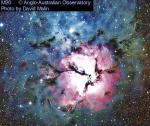 M20: The Trifid Nebula
31.03.1998
Unspeakable beauty and unimaginable bedlam can be found together in the Trifid Nebula. Also known as M20, this photogenic nebula is visible with good binoculars in the constellation of Sagittarius. The energetic processes of star formation create not only the colors but the chaos. The red-glowing gas results from high-energy light striking interstellar hydrogen gas.
|
January February March April May June July August September October |
|||||||||||||||||||||||||||||||||||||||||||||||||