
|
You entered: gas
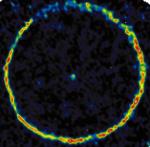 TT Cygni: Carbon Star
4.03.2001
TT Cygni is a cool red giant star with a wind. This false-color picture of TT Cyg was made using a coordinated array of millimeter wavelength radio telescopes and shows radio emission from carbon monoxide (CO) molecules in the surrounding gas.
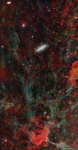 The Deep Sky Toward Andromeda
8.09.2021
What surrounds the Andromeda galaxy? Out in space, Andromeda (M31) is closely surrounded by several small satellite galaxies, and further out it is part of the Local Group of Galaxies -- of which our Milky Way galaxy is also a member.
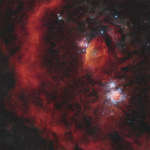 APOD: 2026 February 18 Б Orions Cradle
18.02.2026
Cradled in red-glowing hydrogen gas, stars are being born in Orion. These stellar nurseries lie at the edge of the giant Orion molecular cloud complex, some 1,500 light-years away. This detailed view spans...
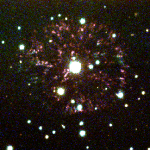 The Firework Nebula
4.07.1995
The Firework Nebula, known to astronomers as "GK Per", is the result of a type of stellar explosion called a nova. In a nova, a very compact star called a white dwarf blasts away gas that had accumulated on its surface.
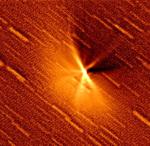 More Jets from Comet Hale-Bopp
13.02.1997
Comets become fountains of gas and dust as they get near the Sun. Solar heat vaporizes the outer layers of these spectacular orbiting icebergs, exposing caverns of pressurized gas that erupt into jets. The above digitally enhanced image of Comet Hale-Bopp was taken on January 29th and highlights several of these dust jets.
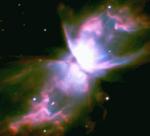 NGC 6302: The Butterfly Nebula
2.06.1998
The Butterfly Nebula is only thousands of years old. As a central star of a binary system aged, it threw off its outer envelopes of gas in a strong stellar wind. The remaining stellar core is so hot it ionizes the previously ejected gas, causing it to glow.
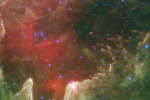 W5: Pillars of Star Creation
16.09.2008
How do stars form? A study of star forming region W5 by the orbiting Spitzer Space Telescope provides clear clues by recording that massive stars near the center of empty cavities are older than stars near the edges.
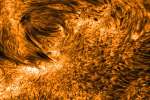 Spicules: Jets on the Sun
2.11.2008
Imagine a pipe as wide as a state and as long as half the Earth. Now imagine that this pipe is filled with hot gas moving 50,000 kilometers per hour. Further imagine that this pipe is not made of metal but a transparent magnetic field.
 APOD: 2025 March 18 Б LDN 1235: The Shark Nebula
18.03.2025
There is no sea on Earth large enough to contain the Shark nebula. This predator apparition poses us no danger as it is composed only of interstellar gas and dust. Dark dust like that featured here is somewhat like cigarette smoke and created in the cool atmospheres of giant stars.
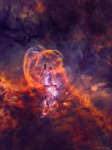 Star Forming Region NGC 3582 without Stars
30.07.2019
What's happening in the Statue of Liberty nebula? Bright stars and interesting molecules are forming and being liberated. The complex nebula resides in the star forming region called RCW 57, and besides the iconic monument, to some looks like a flying superhero or a weeping angel.
|
January February March April May June July August September October |
|||||||||||||||||||||||||||||||||||||||||||||||||