
|
You entered: image
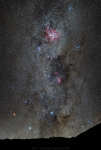 The Southern Cross in a Southern Sky
19.10.2015
Have you ever seen the Southern Cross? This famous constellation is best seen from Earth's Southern Hemisphere. Captured from Rio de Janeiro, Brazil, the four bright stars that mark the Southern Cross are visible just above the horizon in the featured image.
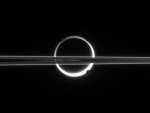 Saturn, Titan, Rings, and Haze
29.07.2013
This is not a solar eclipse. Pictured above is a busy vista of moons and rings taken at Saturn. The large circular object in the center of the image is Titan, the largest moon of Saturn and one of the most intriguing objects in the entire Solar System.
 The Shifting Tails of Comet NEOWISE
12.08.2020
Keep your eye on the ion tail of Comet NEOWISE. A tale of this tail is the trail of the Earth. As with all comets, the blue ion tail always points away from the Sun. But as Comet C/2020 F3 (NEOWISE) rounded our Sun, its ion tail pointed in slightly different directions.
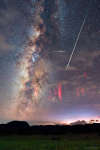 Perseid Meteor, Red Sprites, and Nova RS Oph
16.08.2021
This was an unusual sky. It wasn't unusual because of the central band the Milky Way Galaxy, visible along the image left. Most dark skies show part of the Milky Way. It wasn't unusual because of the bright meteor visible on the upper right.
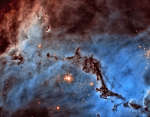 N11: Star Clouds of the LMC
11.02.2013
Massive stars, abrasive winds, mountains of dust, and energetic light sculpt one of the largest and most picturesque regions of star formation in the Local Group of Galaxies. Known as N11, the region...
 Storm Alley on Saturn
2.11.2004
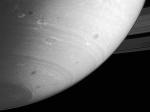
What causes storms on Saturn? To help find out, scientists commanded the robot Cassini spacecraft now orbiting Saturn to inspect a circulating band of clouds nicknamed "Storm Alley." This westwardly moving cloud ring...
 Return To Cydonia
7.04.1998
Yesterday the Mars Global Surveyor project released a new close-up image of a portion of the Cydonia region on Mars. This cropped and processed version shows an area about 2 miles wide (the full...
 M51: The Whirlpool Galaxy from Hubble
13.06.2022
The Whirlpool Galaxy is a classic spiral galaxy. At only 30 million light years distant and fully 60 thousand light years across, M51, also known as NGC 5194, is one of the brightest and most picturesque galaxies on the sky.
 Tracking Saturn's Moons
12.05.1996
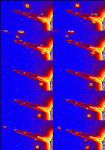
These five pairs of Hubble Space Telescope images track some of Saturn's moons as they orbit the ringed planet. A pair of images was taken every 97 minutes on November 21, 1995 with the Wide Field Planetary Camera-2, the normally bright ring system appearing nearly edge-on.
 Descent to Titan
14.01.2005
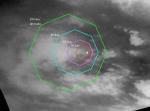
Today's descent to the surface of Titan by the European Space Agency's Huygens probe is the most distant landing ever attempted by a spacecraft from Earth. At 10:13 UT (5:13am...
|
January February March April May June July August September |
|||||||||||||||||||||||||||||||||||||||||||||||||