
|
You entered: image
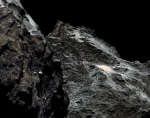 62 Kilometers above Comet Churyumov Gerasimenko
15.09.2014
Spacecraft Rosetta continues to approach, circle, and map Comet Churyumov-Gerasimenko. Crossing the inner Solar System for ten years to reach the vicinity of the comet last month, the robotic spacecraft continues to image the unusual double-lobed comet nucleus. The reconstructed-color image featured, taken about 10 days ago, indicates how dark this comet nucleus is.
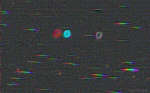 Colors: Ring Nebula versus Stars
21.07.2021
What if you could see, separately, all the colors of the Ring? And of the surrounding stars? There's technology for that. The featured image shows the Ring Nebula (M57) and nearby stars through such technology: in this case, a prism-like diffraction grating.
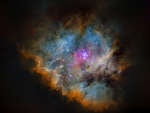 NGC 281: Starless with Stars
19.11.2021
In visible light the stars have been removed from this narrow-band image of NGC 281, a star forming region some 10,000 light-years away toward the constellation Cassiopeia. Stars were digitally added back to the resulting starless image though.
 I Brought You the Moon
1.04.2018
I love you so much that I brought you the Moon. Please take it before this tree becomes more interested. Also the Moon is heavier than I thought. And I foolishly picked it up by the hot side by mistake. But it is for you and, well, the others reading this APOD.
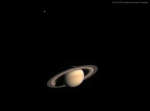 Cassini Approaches Saturn
10.04.2016
Cassini, a robot spacecraft launched in 1997 by NASA, became close enough in 2002 to resolve many rings and moons of its destination planet: Saturn. At that time, Cassini snapped several images during an engineering test. Several of those images were combined into the contrast-enhanced color composite featured here.
 APOD: 2024 December 17 Б Near to the Heart Nebula
17.12.2024
What excites the Heart Nebula? First, the large emission nebula on the upper left, catalogued as IC 1805, looks somewhat like a human heart. The nebula glows brightly in red light emitted by its most prominent element, hydrogen, but this long-exposure image was also blended with light emitted by sulfur (yellow) and oxygen (blue).
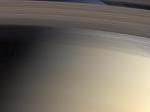 Seeing Through Saturns C Ring
20.09.2004
Are Saturn's rings transparent? The Cassini spacecraft that recently entered orbit around Saturn has confirmed that some of Saturn's rings are more transparent than others. Pictured above, Saturn's main A, B, and C rings can be seen, top to bottom, superposed against the gas giant planet.
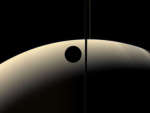 Crescent Rhea Occults Crescent Saturn
3.01.2015
Soft hues, partially lit orbs, a thin trace of the ring, and slight shadows highlight this understated view of the majestic surroundings of the giant planet Saturn. Looking nearly back toward the Sun, the robot Cassini spacecraft now orbiting Saturn captured crescent phases of Saturn and its moon Rhea in color a few years ago.
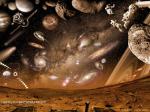 APOD Turns Eleven
16.06.2006
The first APOD appeared eleven years ago today, on 1995 June 16. Although garnering only 14 page views on that day, we are proud to estimate that APOD has now served over 400 million space-related images over the last eleven years.
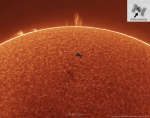 Space Station, Solar Prominences, Sun
4.05.2021
That's no sunspot. It's the International Space Station (ISS) caught passing in front of the Sun. Sunspots, individually, have a dark central umbra, a lighter surrounding penumbra, and no Dragon capsules attached.
|
January February March April May June July August September |
|||||||||||||||||||||||||||||||||||||||||||||||||