
|
You entered: Sun
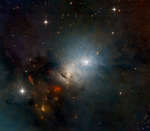 NGC 1333: Stellar Nursery in Perseus
11.11.2021
NGC 1333 is seen in visible light as a reflection nebula, dominated by bluish hues characteristic of starlight reflected by interstellar dust. A mere 1,000 light-years distant toward the heroic constellation Perseus, it lies at the edge of a large, star-forming molecular cloud.
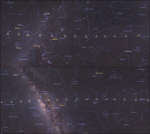 Saturn: 1993 2022
19.08.2022
Saturn is the most distant planet of the Solar System easily visible to the unaided eye. With this extraordinary, long-term astro-imaging project begun in 1993, you can follow the ringed gas giant for one Saturn year as it wanders once around the ecliptic plane, finishing a single orbit around the Sun by 2022.
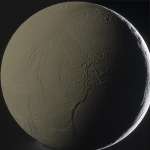 APOD: 2023 February 5 Б Enceladus by Saturnshine
5.02.2023
This moon is shining by the light of its planet. Specifically, a large portion of Enceladus pictured here is illuminated primarily by sunlight first reflected from the planet Saturn. The result is that the normally snow-white moon appears in the gold color of Saturn's cloud tops.
 APOD: 2023 May 9 Б Shadows of Earth
9.05.2023
Can you find two Earth shadows in today's image? It's a bit tricky. To find the first shadow, observe that the top part of the atmosphere appears pink and the lower part appears blue. This is because the top half is exposed to direct sunlight, while the lower part is not.
 Planet Earth at Twilight
27.12.2024
No sudden, sharp boundary marks the passage of day into night in this gorgeous view of ocean and clouds over our fair planet Earth. Instead, the shadow line or terminator is diffuse and shows the gradual transition to darkness we experience as twilight.
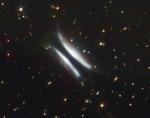 Gomezs Hamburger: A Proto Planetary Nebula
7.08.2002
What, in heaven, is that? Sometimes astronomers see things on the sky they don't immediately understand. In 1985 this happened to Arturo Gomez, and the object became known as Gomez's Hamburger for its distinctive yet familiar shape.
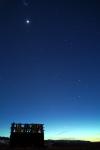 Mercury and Venus in the West
2.04.2004
Doing their part in the ongoing dance of the planets, Mercury and Venus both reached their greatest elongation or maximum apparent distance from the Sun only a few days ago, on March 29th. Eager...
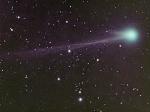 APOD: 2004 August 30- Announcing Comet C 2003 K4 LINEAR
30.08.2004
A comet discovered last year has brightened unexpectedly and now may become visible to the unaided eye within the next month. Designated Comet C/2003 K4 (LINEAR), the comet was discovered in 2003 May by project LINEAR.
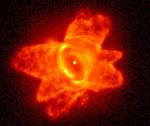 PKS285 02: A Young Planetary Nebula
22.06.1999
How do planetary nebulae acquire their exquisite geometrical shapes? To investigate this, astronomers used the Hubble Space Telescope to image several young planetary nebulae. These nebulae are the outer envelopes of stars like our Sun that have recently been cast away to space, leaving behind a core fading to become a white dwarf.
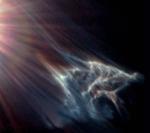 Reflecting Merope
15.07.2006
(xxxedit and linkxxx) In the well known Pleiades star cluster, starlight is slowly destroying this wandering cloud of gas and dust. The star Merope lies just off the upper left edge of this picture from the Hubble Space Telescope.
|
January February March April May June July August September October |
|||||||||||||||||||||||||||||||||||||||||||||||||