
|
You entered: Sun
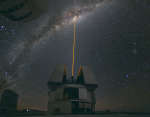 A Laser Strike at the Galactic Center
1.12.2013
Why are these people shooting a powerful laser into the center of our Galaxy? Fortunately, this is not meant to be the first step in a Galactic war. Rather, astronomers at the Very Large Telescope (VLT) site in Chile are trying to measure the distortions of Earth's ever changing atmosphere.
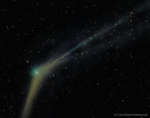 Comet Catalina Emerges
7.12.2015
Comet Catalina is ready for its close-up. The giant snowball from the outer Solar System, known formally as C/2013 US10 (Catalina), rounded the Sun last month and is now headed for its closest approach to Earth in January.
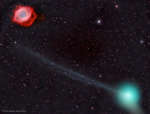 Comet PanSTARRS and the Helix Nebula
5.06.2016
It's rare that such different objects are imaged so close together. Such an occasion is occurring now, though, and was captured two days ago in combined parallel exposures from the Canary Islands of Spain.
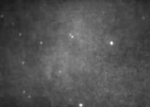 Flashes of the Crab Pulsar
9.02.2021
It somehow survived an explosion that would surely have destroyed our Sun. Now it is spins 30 times a second and is famous for the its rapid flashes. It is the Crab Pulsar, the rotating neutron star remnant of the supernova that created the Crab Nebula.
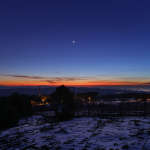 Twilight with Moon and Planets
21.02.2026
Only two days after the February New Moon's annular eclipse of the Sun, a slender lunar crescent poses above the western horizon after sunset in this wintry twilight skyscape. Its nightside faintly illuminated...
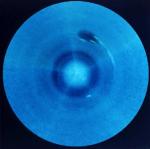 Southern Neptune
27.06.1998
Neptune, the Solar System's outermost gas giant planet, is 30 times farther from the Sun than Earth. Twelve years after a 1977 launch, Voyager 2 flew by Neptune and found surprising activity on a planet that receives only 3 percent as much sunlight as Jupiter.
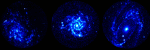 A Spiral Galaxy Gallery
14.03.1998
A progression of beautiful spiral galaxies is illustrated above with three photographs from NASA's Ultraviolet Imaging Telescope (UIT). Flying above the Earth's obscuring layer of atmosphere on the Space Shuttle Columbia during...
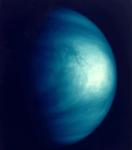 Venus: Just Passing By
12.06.1999
Venus, the second closest planet to the Sun, is a popular way-point for spacecraft headed for the gas giant planets in the outer reaches of the solar system. Why visit Venus first? Using...
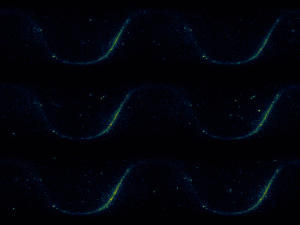 Simulated Gamma ray Sky
31.05.2006
Scheduled for launch in 2007, the Gamma-ray Large Area Space Telescope (GLAST) will explore the Universe in gamma-rays, the most energetic form of light. To get ready, consider this dynamic gamma-ray sky animation - constructed from simulating the first 55 days (seen above at one frame per day) of GLAST observations of cosmic gamma-ray sources.
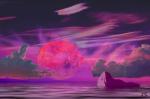 Sunrise from the Surface of Gliese 581c
2.05.2007
How might a sunrise appear on Gliese 581c? One artistic guess is shown above. Gliese 581c is the most Earth-like planet yet discovered and lies a mere 20 light-years distant. The central red dwarf...
|
January February March April May June July August September October |
|||||||||||||||||||||||||||||||||||||||||||||||||