
|
You entered: Sun
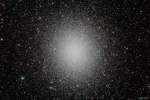 Star Cluster Omega Centauri in HDR
11.07.2017
Behold the largest ball of stars in our galaxy. Omega Centauri is packed with about 10 million stars, many older than our Sun and packed within a volume of only about 150 light-years in diameter.
 Black Hole Safety Video
1.10.2019
If you were a small one-eyed monster, would you want to visit a black hole? Well the one in this video does -- but should it? No, actually, but since our little friend is insistent on going, the video informs it what black holes really are, and how to be as safe as possible when visiting.
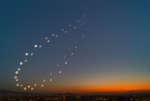 A Double Lunar Analemma over Turkey
10.10.2022
An analemma is that figure-8 curve you get when you mark the position of the Sun at the same time each day for one year. But the trick to imaging an analemma of the Moon is to wait bit longer.
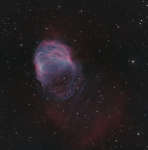 The Medusa Nebula
17.03.2023
Braided and serpentine filaments of glowing gas suggest this nebula's popular name, The Medusa Nebula. Also known as Abell 21, this Medusa is an old planetary nebula some 1,500 light-years away in the constellation Gemini. Like its mythological namesake, the nebula is associated with a dramatic transformation.
 APOD: 2024 June 5 Б Shadow of a Martian Robot
5.06.2024
What if you saw your shadow on Mars and it wasn't human? Then you might be the Perseverance rover exploring Mars. Perseverance has been examining the Red Planet since 2021, finding evidence of its complex history of volcanism and ancient flowing water, and sending breathtaking images across the inner Solar System.
 APOD: 2024 August 14 Б Meteors and Aurora over Germany
14.08.2024
This was an unusual night. For one thing, the night sky of August 11 and 12, earlier this week, occurred near the peak of the annual Perseid Meteor Shower. Therefore, meteors streaked across the dark night as small bits cast off from Comet Swift-Tuttle came crashing into the Earth's atmosphere.
 Young Star Cluster NGC 1333
12.09.2024
This spectacular mosaic of images from the James Webb Space Telescope peers into the heart of young star cluster NGC 1333. A mere 1,000 light-years distant toward the heroic constellation Perseus, the nearby star cluster lies at the edge of the large Perseus molecular cloud.
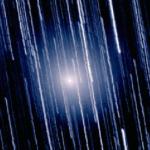 Tempel-Tuttle: The Leonid Comet
30.01.1998
Star trails streak this composite time exposure of Comet Tempel-Tuttle recorded by T. Puckett on January 26. Presently passing through the inner solar system on its 33 year orbit around the Sun, Tempel-Tuttle has brightened unexpectedly, but binoculars or small telescopes are still required to visually observe it.
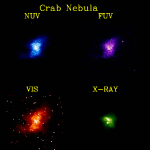 The High Energy Crab Nebula
9.09.1996
This is the mess that is left when a star explodes. The Crab Nebula is so energetic that it glows in every kind of light known. Shown above are images of the Crab Nebula from visible light to the X-ray band.
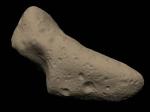 Asteroid Eros Reconstructed
5.06.2001
Orbiting the Sun between Mars and Earth, asteroid 433 Eros was visited by the robot spacecraft NEAR-Shoemaker in 2000 February. Some of the 100,000+ images taken by NEAR of the tumbling space rock have been combined into the above high-resolution composite.
|
January February March April May June July August September October |
|||||||||||||||||||||||||||||||||||||||||||||||||