
|
You entered: Sun
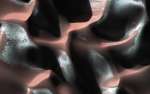 Martian Chiaroscuro
29.08.2020
Deep shadows create dramatic contrasts between light and dark in this high-resolution close-up of the martian surface. Recorded on January 24, 2014 by the HiRISE camera on board the Mars Reconnaissance Orbiter, the scene spans about 1.5 kilometers.
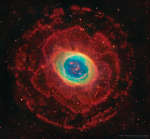 Rings Around the Ring Nebula
18.08.2021
The Ring Nebula (M57), is more complicated than it appears through a small telescope. The easily visible central ring is about one light-year across, but this remarkably deep exposure - a collaborative effort combining data from three different large telescopes - explores the looping filaments of glowing gas extending much farther from the nebula's central star.
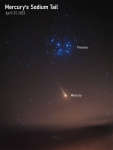 Mercurys Sodium Tail
3.05.2022
That's no comet. Below the Pleiades star cluster is actually a planet: Mercury. Long exposures of our Solar System's innermost planet may reveal something unexpected: a tail. Mercury's thin atmosphere contains small amounts of sodium that glow when excited by light from the Sun.
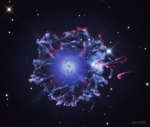 Halo of the Cats Eye
3.08.2022
What created the unusual halo around the Cat's Eye nebula? No one is sure. What is sure is that the Cat's Eye Nebula (NGC 6543) is one of the best known planetary nebulae on the sky.
 Rigel Wide
7.04.2023
Brilliant, blue, supergiant star Rigel marks the foot of Orion the Hunter in planet Earth's night. Designated Beta Orionis, it's at the center of this remarkably deep and wide field of view.
 APOD: 2025 May 12 Б Gaia Reconstructs a Side View of our Galaxy
12.05.2025
What does our Milky Way Galaxy look like from the side? Because we are on the inside, humanity canБt get an actual picture. Recently, however, just such a map has been made using location data for over a billion stars from ESAБs Gaia mission.
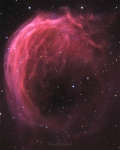 APOD: 2026 September 29 Б Sh2 188: The Shrimp Nebula
29.09.2026
What causes the swirl in the Shrimp Nebula? Its high speed is likely. What is sure is that Sh2-188 is one of the larger planetary nebulas on the night sky, by angular size, spanning about half the diameter of the Moon.
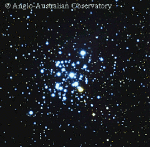 NGC 3293: A Bright Young Open Cluster
23.08.1996
Hot Blue stars shine brightly in this beautiful, recently formed galactic or "open" star cluster. Open cluster NGC 3293 is located in the constellation Carina, lies at a distance of about 8000 light years, and has a particularly high abundance of these young bright stars.
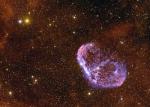 A Crescent Nebula Star Field
15.04.2003
What caused the Crescent Nebula? Looking like an emerging space cocoon, the Crescent Nebula, visible on the right, was created by the brightest star in its center. A leading progenitor hypothesis has the Crescent Nebula beginning to form about 250,000 years ago.
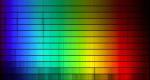 Stellar Spectral Types: OBAFGKM
18.04.2004
Astronomers divide stars into different spectral types. First started in the 1800s, the spectral type was originally meant to classify the strength of hydrogen absorption lines. A few types that best describe the temperature of the star remain in use today.
|
January February March April May June July August September October |
|||||||||||||||||||||||||||||||||||||||||||||||||