
|
You entered: Sun
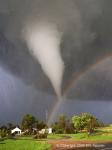 Tornado and Rainbow Over Kansas
13.06.2005
The scene might have been considered serene if it weren't for the tornado. Last June in Kansas, storm chaser Eric Nguyen photographed this budding twister in a different light -- the light of a rainbow. Pictured above, a white tornado cloud descends from a dark storm cloud.
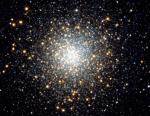 Hydrogen, Helium, and the Stars of M10
12.03.1999
Stars like the Sun use hydrogen for fuel, "burning" hydrogen into helium at their cores through nuclear fusion. But what happens when that hydrogen runs out? For a while, hydrogen burns in a shell surrounding the stellar core and the star expands to become a red giant.
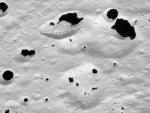 Iapetus in Black and White
14.09.2007
Iapetus, Saturn's third largest moon, is a candidate for the strangest moon of Saturn. Tidally locked in its orbit around the ringed gas giant, Iapetus is sometimes called the yin-yang moon because...
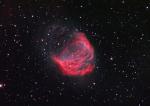 The Medusa Nebula
23.11.2007
Braided, serpentine filaments of glowing gas suggest this nebula's popular name, The Medusa Nebula. Also known as Abell 21, this Medusa is an old planetary nebula some 1,500 light-years away in the constellation Gemini. Like its mythological namesake, the nebula is associated with a dramatic transformation.
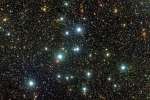 M39: Open Cluster in Cygnus
12.04.2009
Lying just at the limit of human perception is a picturesque starfield containing one of the larger open clusters on the northern sky. Spanning an angle larger than the Moon, M39's relatively few stars lie only about 800 light years distant toward the constellation of Cygnus.
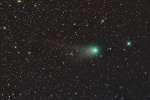 Tails of Comet Garradd
20.10.2011
A good target for binoculars and small telescopes, Comet Garradd (C/2009 P1) now shines in planet Earth's evening skies, a steady performer but just below naked-eye visibility. Telescopic images like this composite from...
 The Medusa Nebula
25.10.2012
Braided, serpentine filaments of glowing gas suggest this nebula's popular name, The Medusa Nebula. Also known as Abell 21, this Medusa is an old planetary nebula some 1,500 light-years away in the constellation Gemini. Like its mythological namesake, the nebula is associated with a dramatic transformation.
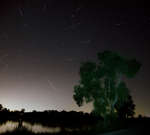 Perseid Meteors Over Ontario
13.08.2013
Where are all of these meteors coming from? In terms of direction on the sky, the pointed answer is the constellation of Perseus. That is why the meteor shower that peaked over the past few days is known as the Perseids -- the meteors all appear to come from a radiant toward Perseus.
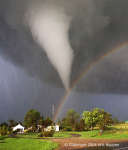 Tornado and Rainbow Over Kansas
22.11.2014
The scene might have been considered serene if it weren't for the tornado. During 2004 in Kansas, storm chaser Eric Nguyen photographed this budding twister in a different light -- the light of a rainbow. Featured here, a white tornado cloud descends from a dark storm cloud.
 The Medusa Nebula
12.06.2015
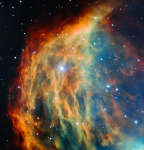
Braided, serpentine filaments of glowing gas suggest this nebula's popular name, The Medusa Nebula. Also known as Abell 21, this Medusa is an old planetary nebula some 1,500 light-years away along the southern border of the constellation Gemini. Like its mythological namesake, the nebula is associated with a dramatic transformation.
|
January February March April May June July August September October |
|||||||||||||||||||||||||||||||||||||||||||||||||