
|
You entered: Sun
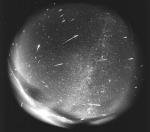 Leonids from Leo
4.11.2001
Is Leo leaking? Leo, the famous sky constellation visible on the left of the above all-sky photograph, appears to be the source of all the meteors seen in 1998's Leonids Meteor Shower. That...
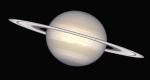 Natural Saturn On The Cassini Cruise
11.05.2002
What could you see approaching Saturn aboard an interplanetary cruise ship? Your view would likely resemble this subtly shaded image of the gorgeous ringed gas giant. Processed by the Hubble Heritage project, the picture...
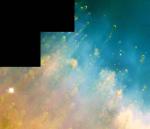 At the Edge of the Helix Nebula
12.05.2002
While exploring the inner edge of the Helix Nebula with the Hubble Space Telescope's Wide Field Planetary Camera 2, astronomers were able to produce this striking image - rich in details of an exotic environment.
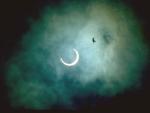 A Fleeting Eclipse
8.06.2002
A lunar eclipse can be viewed in a leisurely fashion. Visible to anyone on the night side of planet Earth (weather permitting), totality often lasts an hour or so as the moon glides through the Earth's shadow. But a solar eclipse is more fleeting.
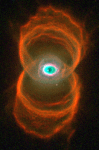 MyCn18: An Hourglass Nebula
18.01.1996
The sands of time are running out for the central star of this hourglass-shaped planetary nebula. With its nuclear fuel exhausted, this brief, spectacular, closing phase of a Sun-like star's life occurs as its outer layers are ejected - its core becoming a cooling, fading White Dwarf.
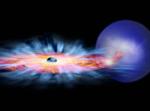 Wind from a Black Hole
1.07.2006
Binary star system GRO J1655-40 consists of a relatively normal star about twice as massive as the Sun co-orbiting with a black hole of about seven solar masses. This striking artist's vision of the exotic binary system helps visualize matter drawn from the normal star by gravity and swirling toward the black hole.
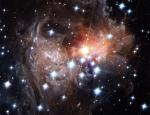 V838 Mon: Echoes from the Edge
3.11.2006
Variable star V838 Monocerotis lies near the edge of our Milky Way Galaxy, about 20,000 light-years from the Sun. Still, ever since a sudden outburst was detected in January 2002, this enigmatic star has taken the center of an astronomical stage.
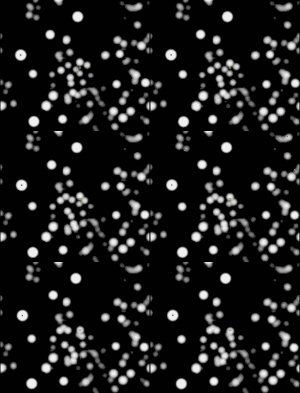 Sgr A*: Fast Stars Near the Galactic Center
14.01.2007
Why are these stars moving so fast? Shown above is a time-lapse movie in infrared light detailing how stars in the central light-year of our Galaxy have moved over the past eight years.
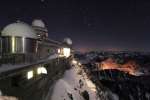 Winter Night at Pic du Midi
25.01.2008
This dreamlike view looking south from the historic mountain top Pic du Midi Observatory combines moonlit domes, a winter night sky, and the snowy peaks of the French Pyrenees. Encroaching on the night, lights...
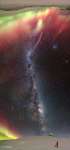 Milky Way and Aurora over Antarctica
27.07.2015
It has been one of the better skies of this long night. In parts of Antarctica, not only is it winter, but the Sun can spend weeks below the horizon. At China's Zhongshan Station, people sometimes venture out into the cold to photograph a spectacular night sky.
|
January February March April May June July August September October |
|||||||||||||||||||||||||||||||||||||||||||||||||