
|
You entered: Sun
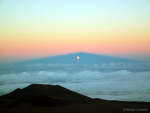 Moonrise Through Mauna Keas Shadow
10.03.2019
How can the Moon rise through a mountain? It cannot -- what was photographed here is a moonrise through the shadow of a large volcano. The volcano is Mauna Kea, Hawai'i, USA, a frequent spot for spectacular photographs since it is one of the premier observing locations on planet Earth.
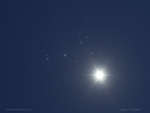 Venus and the Sisters
4.04.2020
After wandering about as far from the Sun on the sky as Venus can get, the brilliant evening star is crossing paths with the sister stars of the Pleiades cluster. Look west after sunset and you can share the ongoing conjunction with skygazers around the world.
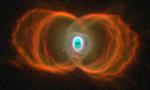 MyCn18: An Hourglass Nebula
4.06.2000
The sands of time are running out for the central star of this hourglass-shaped planetary nebula. With its nuclear fuel exhausted, this brief, spectacular, closing phase of a Sun-like star's life occurs as its outer layers are ejected - its core becoming a cooling, fading White Dwarf.
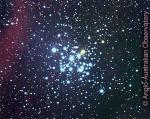 NGC 3293: A Bright Young Open Cluster
9.09.2001
Hot blue stars shine brightly in this beautiful, recently formed galactic or "open" star cluster. Open cluster NGC 3293 is located in the constellation Carina, lies at a distance of about 8000 light years, and has a particularly high abundance of these young bright stars.
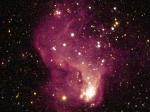 Star Forming Region Hubble V
25.12.2001
How did stars form in the early universe? Astronomers are gaining insight by studying NGC 6822, a nearby galaxy classified as irregular by modern standards but appearing more typical of galaxies billions of years ago. Inspection of NGC 6822 shows several bright star groups, including two dubbed Hubble-X and Hubble-V.
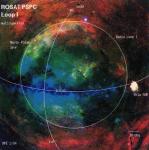 Loop I in the Northern Sky
3.05.1999
One of the largest coherent structures on the sky is known simply as Loop I and can best be seen in radio and X-ray maps. Spanning over 100 degrees, part of Loop I appears so prominent in northern sky maps that it is known as the North Polar Spur (NPS).
 The Galactic Center in Infrared
21.06.1999
The center of our Galaxy is a busy place. In visible light, much of the Galactic Center is obscured by opaque dust. In infrared light, however, dust glows more and obscures less, allowing nearly one million stars to be recorded in the above photograph.
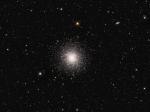 M13: The Great Globular Cluster in Hercules
18.05.2007
In 1714, Edmond Halley noted that M13 "shows itself to the naked eye when the sky is serene and the Moon absent." Of course, M13 is now modestly recognized as the Great Globular Cluster in Hercules, one of the brightest globular star clusters in the northern sky.
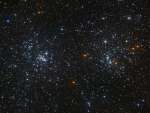 Double Cluster in Perseus
7.12.2007
Skygazers recently following Comet Holmes have probably also chanced across this lovely starfield, not far from the comet on the sky in the constellation Perseus. Some 7,000 light-years away, this pair of open or galactic star clusters is an easy binocular target and is visible to the unaided eye from dark sky areas.
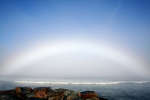 A Fog Bow Over Ocean Beach
29.05.2008
What is that white arch over the water? What is being seen is a fogbow, a reflection of sunlight by water drops similar to a rainbow but without the colors. The fog itself is not confined to an arch -- the fog is mostly transparent but relatively uniform.
|
January February March April May June July August September October |
|||||||||||||||||||||||||||||||||||||||||||||||||