
|
You entered: planets
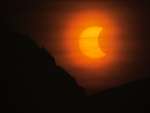 Solar Eclipse over Antarctica
2.12.2011
Last Friday, the fourth and final partial solar eclipse of 2011 was only visible from high latitudes in the southern hemisphere. If you missed it, check out this dramatic picture of the geocentric celestial event from a very high southern latitude on the continent of Antarctica.
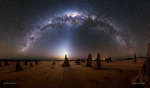 Milky Way over the Pinnacles in Australia
17.02.2016
What strange world is this? Earth. In the foreground of the featured image are the Pinnacles, unusual rock spires in Nambung National Park in Western Australia. Made of ancient sea shells (limestone), how these human-sized picturesque spires formed remains unknown.
 Apollo 15 Panorama
5.08.2016
On July 31, 1971, Apollo 15 astronauts Jim Iwrin and Dave Scott deployed the first Lunar Roving Vehicle on the Moon. Using it to explore their Hadley-Apennine landing site they spent nearly three days on the Moon while Al Worden orbited above.
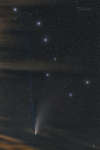 Remembering NEOWISE
31.07.2021
It was just last July. If you could see the stars of the Big Dipper, you could find Comet NEOWISE in your evening sky. After sunset denizens of the north could look for the naked-eye comet below the bowl of that famous celestial kitchen utensil and above the northwestern horizon.
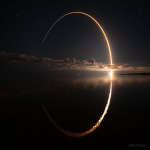 Lucy Launches to Eight Asteroids
20.10.2021
Why would this mission go out as far as Jupiter -- but then not visit Jupiter? Lucy's plan is to follow different leads about the origin of our Solar System than can be found at Jupiter -- where Juno now orbits.
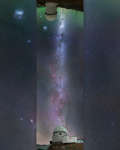 A 10 000 Kilometer Galactic Bridge
3.06.2022
With this creative astro-collaboration you can follow the plane of our Milky Way Galaxy as it bridges northern and southern hemisphere skies. To construct the expansive composite nightscape, skies over Observatorio El Sauce...
 APOD: 2025 March 9 Б Cyclones at Jupiters North Pole
9.03.2025
Why are there so many cyclones around the north pole of Jupiter? The topic is still being researched. NASA's robotic Juno mission orbiting Jupiter took data in 2018 that was used to construct this stunning view of the curious cyclones at Jupiter's north pole.
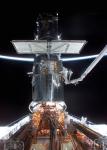 SM3B: Mission to Hubble
14.03.2002
Now complete, Servicing Mission 3B (SM3B) was really the fourth trip to the Hubble Space Telescope, as the originally planned mission 3 was split into two parts. Falling around planet Earth, about 320 nautical...
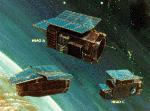 A High Energy Fleet
25.02.1996
Looking like a fleet of futuristic starcruisers poised over planet Earth, NASA's highly successful series of High Energy Astrophysical Observatory (HEAO) spacecraft appear above in a vintage illustration. Labeled A, B, and C in this conceptual picture, the spacebased telescopes were known as HEAO-1, HEAO-2, and HEAO-3 respectively.
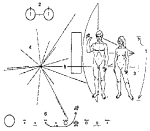 Greetings from the Pioneers
30.06.1996
Launched in the early 1970s Pioneer 10 and 11 were appropriately named - becoming the first spacecraft to travel through the asteroid belt, first to fly by Jupiter and Saturn, and the first human artifacts to venture beyond the solar system.
|
January February March April May June July August September October |
|||||||||||||||||||||||||||||||||||||||||||||||||