
|
You entered: planets
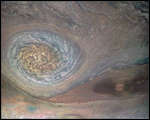 North North Temperate Zone Little Red Spot
4.08.2017
On July 11, the Juno spacecraft once again swung near the turbulent Jovian cloud tops. On its seventh orbital closest approach this perijove passage brought Juno within 3,500 kilometers of the Solar System's largest planetary atmosphere.
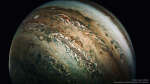 Enhanced: The Dolphin Cloud on Jupiter
15.04.2019
Do you see the dolphin-shaped cloud on Jupiter? The cloud was visible last year during perijove 16, the sixteenth time that NASA's robotic spacecraft Juno passed near Jupiter since it arrived in mid-2016. During each perijove, Juno passes near a slightly different part of Jupiter's cloud tops.
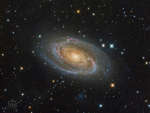 Messier 81
17.04.2019
One of the brightest galaxies in planet Earth's sky is similar in size to our Milky Way Galaxy: big, beautiful Messier 81. Also known as NGC 3031 or Bode's galaxy for its 18th century discoverer, this grand spiral can be found toward the northern constellation of Ursa Major, the Great Bear.
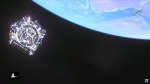 James Webb Space Telescope over Earth
26.12.2021
There's a big new telescope in space. This one, the James Webb Space Telescope (JWST), not only has a mirror over five times larger than Hubble's in area, but can see better in infrared light.
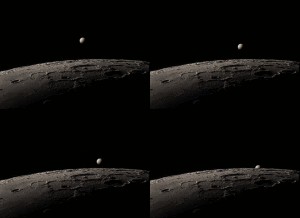 Lunar Occultation of Venus
2.06.2022
On May 27 Venus rose as the morning star, near the waning crescent Moon in a predawn sky already full of planets. It was close on the sky to the Moon's crescent and a conjunction of the second an third brightest celestial beacons were enjoyed by skygazers around the world.
 APOD: 2025 June 20 Б Major Lunar Standstill 2024 2025
20.06.2025
Edmonton, Alberta, Canada, planet Earth lies on the horizon. in this stack of panoramic composite images. In a monthly time series arranged vertically top to bottom the ambitious photographic project follows the annual north-south swing of sunrise points, from June solstice to December solstice and back again.
 APOD: 2025 July 4 Б NGC 6946 and NGC 6939
4.07.2025
Face-on spiral galaxy NGC 6946 and open star cluster NGC 6939 share this cosmic snapshot, composed with over 68 hours of image data captured with a small telescope on planet Earth. The field of view spans spans about 1 degree or 2 full moons on the sky toward the northern constellation Cepheus.
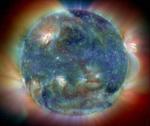 Solstice Celebration
21.06.2000
Season's greetings! At 01:48 Universal Time on June 21 the Sun reaches its northernmost point in planet Earth's sky marking a season change and the first solstice of the year 2000. In celebration, consider this delightfully detailed, brightly colored image of the active Sun.
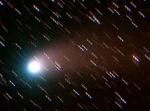 Comet McNaught Hartley
14.03.2001
Outbound and climbing above the plane of our solar system, comet McNaught-Hartley (C/1999 T1) is presently soaring through northern skies. This telescopic picture, a composite of many 30 second exposures made through three color filters, recorded the delicate colors in its diminutive coma and faint tail on February 26th.
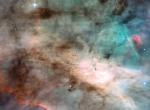 In the Center of the Omega Nebula
1.05.2002
In the depths of the dark clouds of dust and molecular gas known as the Omega Nebula, stars continue to form. The above image from the Hubble Space Telescope's newly installed Advanced Camera for Surveys shows unprecedented detail in the famous star-forming region.
|
January February March April May June July August September October |
|||||||||||||||||||||||||||||||||||||||||||||||||