
|
You entered: gas
 APOD: 2024 May 8 Б Visualization: A Black Hole Accretion Disk
8.05.2024
What would it look like to circle a black hole? If the black hole was surrounded by a swirling disk of glowing and accreting gas, then the great gravity of the black hole would deflect light emitted by the disk to make it look very unusual. The featured animated video gives a visualization.
 APOD: 2026 March 30 Б Peculiar Elliptical Galaxy Centaurus A
30.03.2026
What's happened to the center of this galaxy? Dramatic dust lanes run across the center of unusual elliptical galaxy Centaurus A. These dust lanes are so thick they almost completely obscure the galaxy's center in visible light.
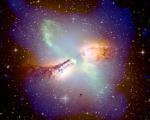 The Colors and Mysteries of Centaurus A
12.08.2002
Why is spiral galaxy Centaurus A in so much turmoil? The above composite image shows different clues to the unusual galaxy's past in different bands of light. In low energy radio waves, shown in red, lobes across the thick swath of dust glow brightly.
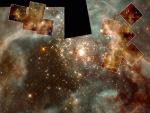 Massive Stars of 30 Doradus
22.06.2003
In the center of star-forming region 30 Doradus lies a huge cluster of the largest, hottest, most massive stars known. These stars and part of the surrounding nebula are captured here in this gorgeous visible-light Hubble Space Telescope image.
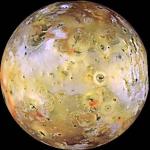 Io's Surface: Under Construction
21.03.1997
Like the downtown area of your favorite city, the roads you drive to work on, and any self-respecting Web site ... Io's surface is constantly under construction. This moon of Jupiter holds the distinction of being the Solar System's most volcanically active body -- its bizarre looking surface continuously formed and reformed by lava flows.
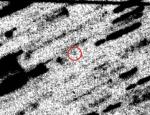 Cold Comet Halley
3.10.2003
While this may not be the most esthetic image of Comet Halley that you have ever seen, it is likely the most unique. The tiny cluster of pixels circled is the famous comet along...
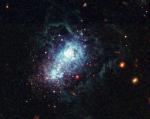 I Zwicky 18: Young Galaxy
3.12.2004
The Milky Way is an ordinary 12 billion year old spiral galaxy, and even our middle-aged Sun is pushing 4.5 billion years. But all the stars in dwarf galaxy I Zwicky 18 are much younger.
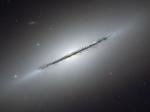 Edge On Galaxy NGC 5866
12.06.2006
Why is this galaxy so thin? Many disk galaxies are actually just as thin as NGC 5866, pictured above, but are not seen edge-on from our vantage point. One galaxy that is situated edge-on is our own Milky Way Galaxy.
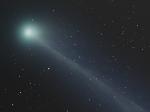 The Ghostly Tail of Comet SWAN
6.11.2006
What causes the structure in Comet SWAN's tail? Comet SWAN, which unexpectedly flared up to naked-eye brightness last week, has been showing detail in its ion tail that might be described as ghostly.
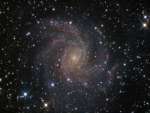 Facing NGC 6946
15.08.2008
From our vantage point in the Milky Way Galaxy, we see NGC 6946 face-on. The big, beautiful spiral galaxy is located just 10 million light-years away, behind a veil of foreground dust and stars in the high and far-off constellation of Cepheus.
|
January February March April May June July August September October |
|||||||||||||||||||||||||||||||||||||||||||||||||