
|
You entered: gas
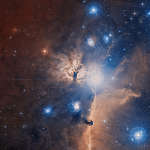 Inside the Flame Nebula
10.05.2014
The Flame Nebula stands out in this optical image of the dusty, crowded star forming regions toward Orion's belt, a mere 1,400 light-years away. X-ray data from the Chandra Observatory and infrared images from the Spitzer Space Telescope can take you inside the glowing gas and obscuring dust clouds though.
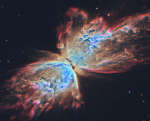 The Butterfly Nebula from Hubble
1.10.2014
The bright clusters and nebulae of planet Earth's night sky are often named for flowers or insects. Though its wingspan covers over 3 light-years, NGC 6302 is no exception. With an estimated surface...
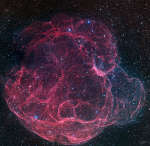 Simeis 147: Supernova Remnant
21.11.2019
It's easy to get lost following the intricate looping filaments in this detailed image of supernova remnant Simeis 147. Also cataloged as Sharpless 2-240 it goes by the popular nickname, the Spaghetti Nebula.
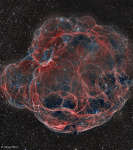 Simeis 147: Supernova Remnant
10.12.2020
It's easy to get lost following the intricate looping filaments in this detailed image of supernova remnant Simeis 147. Also cataloged as Sharpless 2-240 it goes by the popular nickname, the Spaghetti Nebula.
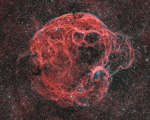 Supernova Remnant Simeis 147
13.01.2022
It's easy to get lost following the intricate, looping, twisting filaments in this detailed image of supernova remnant Simeis 147. Also cataloged as Sharpless 2-240 it goes by the popular nickname, the Spaghetti Nebula.
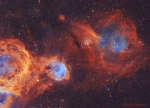 Carina Nebula North
31.01.2022
The Great Carina Nebula is home to strange stars and iconic nebulas. Named for its home constellation, the huge star-forming region is larger and brighter than the Great Orion Nebula but less well known because it is so far south -- and because so much of humanity lives so far north.
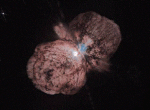 Doomed Star Eta Carinae
11.06.1996
Eta Carinae may be about to explode. But no one knows when - it may be next year, it may be one million years from now. Eta Carinae's mass - about 100 times greater than our Sun - make it an excellent candidate for a full blown supernova.
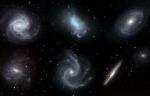 Visitors Galaxy Gallery
27.04.2001
A tantalizing assortment of island universes is assembled here. From top left to bottom right are the lovely but distant galaxies M61, NGC 4449, NGC 4725, NGC 5068, NGC 5247, and NGC 5775/5774. Most are spiral galaxies more or less like our own Milky Way.
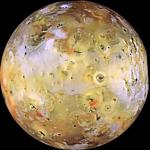 Io s Surface: Under Construction
19.10.2002
Like the downtown area of your favorite city, the roads you drive to work on, and any self-respecting web site ... Io's surface is constantly under construction. This moon of Jupiter holds the distinction of being the Solar System's most volcanically active body -- its bizarre looking surface continuously formed and reformed by lava flows.
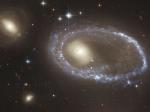 Ring Galaxy AM 0644 741 from Hubble
26.04.2004
How could a galaxy become shaped like a ring? The rim of the blue galaxy pictured on the right is an immense ring-like structure 150,000 light years in diameter composed of newly formed, extremely bright, massive stars.
|
January February March April May June July August September October |
|||||||||||||||||||||||||||||||||||||||||||||||||