
|
You entered: gas
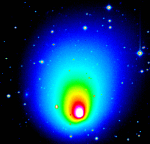 Hale-Bopp on Schedule
25.07.1996
Late March and early April of 1996 marked a banner season for viewing the spectacular naked-eye comet Hyakutake. The spring of 1997 could well offer a similar cometary wonder, Comet Hale-Bopp. Discovered last year while approaching the inner solar sytem Hale-Bopp has been eagerly watched for signs that it will indeed brighten spectacularly.
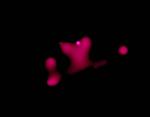 The Heart in NGC 346
14.02.2003
Yes, it's Valentine's Day (!) and looking toward star cluster NGC 346 in our neighboring galaxy the Small Magellanic Cloud, astronomers have noted this heart-shaped cloud of hot, x-ray emitting gas in the cluster's central region.
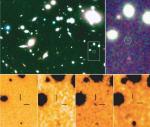 Redshift 10: Evidence for a New Farthest Galaxy
17.03.2004
What's the farthest galaxy known? The answer keeps changing as astronomers compete to find galaxies that top the list. The new claimed record holder is now the faint smudge indicated in the above images by an 8.2-meter Very Large Telescope (VLT) operating in Chile.
 Arp 188 and the Tadpole s Tidal Tail
15.05.2004
In this stunning vista recorded with the Hubble Space Telescope's Advanced Camera for Surveys, distant galaxies form a dramatic backdrop for disrupted spiral galaxy Arp 188, the Tadpole Galaxy. The cosmic tadpole is a mere 420 million light-years distant toward the northern constellation Draco.
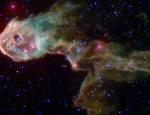 Inside The Elephant's Trunk
9.04.2005
In December of 2003, the world saw spectacular first images from the Spitzer Space Telescope, including this penetrating interior view of an otherwise opaque dark globule known as the Elephant's Trunk Nebula. Seen...
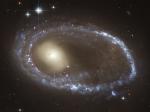 Ring Galaxy AM 0644 741 from Hubble
22.10.2005
How could a galaxy become shaped like a ring? The rim of the blue galaxy pictured on the right is an immense ring-like structure 150,000 light years in diameter composed of newly formed, extremely bright, massive stars.
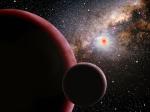 Super Earths May Circle Other Stars
20.03.2006
Are "super-Earths" common around other star systems? Quite possibly. Unexpected evidence for this came to light recently when a planet orbiting a distant star gravitationally magnified the light of an even more distant star.
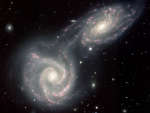 The Colliding Spiral Galaxies of Arp 271
21.07.2008
What will become of these galaxies? Spiral galaxies NGC 5426 and NGC 5427 are passing dangerously close to each other, but each is likely to survive this collision. Most frequently when galaxies collide, a large galaxy eats a much smaller galaxy.
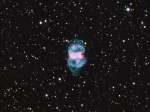 M76 Above and Below
21.11.2008
Also known by the popular name the "Little Dumbbell Nebula", M76 is one of the fainter objects listed in Charles Messier's 18th century Catalog of Nebulae and Star Clusters. Like its better-known namesake M27 (the Dumbbell Nebula), M76 is recognized as a planetary nebula - a gaseous shroud cast off by a dying sunlike star.
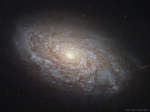 NGC 4414: A Flocculent Spiral Galaxy
20.11.2016
How much mass do flocculent spirals hide? The featured true color image of flocculent spiral galaxy NGC 4414 was taken with the Hubble Space Telescope to help answer this question. The featured image was augmented with data from the Sloan Digital Sky Survey (SDSS).
|
January February March April May June July August September October |
|||||||||||||||||||||||||||||||||||||||||||||||||