
|
You entered: gas
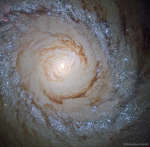 Starburst Galaxy M94 from Hubble
31.07.2022
Why does this galaxy have a ring of bright blue stars? Beautiful island universe Messier 94 lies a mere 15 million light-years distant in the northern constellation of the Hunting Dogs (Canes Venatici).
 APOD: 2025 August 27 Б WISPIT 2b: Exoplanet Carves Gap in Birth Disk
27.08.2025
That yellow spot -- what is it? It's a young planet outside our Solar System. The featured image from the Very Large Telescope in Chile surprisingly captures a distant scene much like our own Solar System's birth, some 4.5 billion years ago.
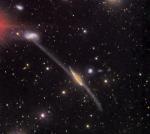 Peculiar Arp 295
10.10.2003
A spectacular bridge of stars and gas stretches for nearly 250,000 light-years and joins this famous peculiar pair of galaxies cataloged as Arp 295. The cosmic bridge between the galaxies and the long...
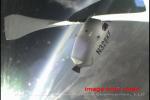 SpaceShipOne Wins the X Prize
5.10.2004
Human space flight has entered the domain of private companies. Previously, large countries like the US and Russia have hired privately owned civilian companies to do specific tasks in support of their public human space flight programs.
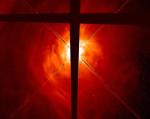 AB Aurigae: How To Make Planets
11.06.1999
This enhanced Hubble Space Telescope image shows in remarkable detail the inner portion of the disk of dust and gas surrounding the star AB Aurigae. Knots of material, visible here for the first time...
 Io s Surface: Under Construction
17.08.2008
Like the downtown area of your favorite city, the roads you drive to work on, and any self-respecting web site ... Io's surface is constantly under construction. This moon of Jupiter holds the distinction of being the Solar System's most volcanically active body -- its bizarre looking surface continuously formed and reformed by lava flows.
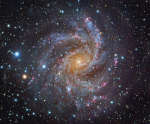 Facing NGC 6946
9.01.2012
From our vantage point in the Milky Way Galaxy, we see NGC 6946 face-on. The big, beautiful spiral galaxy is located just 10 million light-years away, behind a veil of foreground dust and stars in the high and far-off constellation of Cepheus.
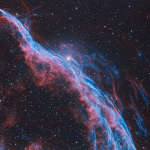 NGC 6960: The Witch s Broom Nebula
29.05.2013
Ten thousand years ago, before the dawn of recorded human history, a new light would have suddenly have appeared in the night sky and faded after a few weeks. Today we know this light was from a supernova, or exploding star, and record the expanding debris cloud as the Veil Nebula, a supernova remnant.
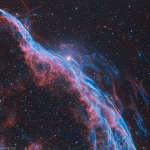 NGC 6960: The Witchs Broom Nebula
8.04.2018
Ten thousand years ago, before the dawn of recorded human history, a new light would have suddenly have appeared in the night sky and faded after a few weeks. Today we know this light was from a supernova, or exploding star, and record the expanding debris cloud as the Veil Nebula, a supernova remnant.
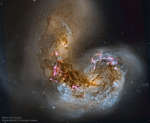 Spiral Galaxy NGC 4038 in Collision
23.05.2018
This galaxy is having a bad millennium. In fact, the past 100 million years haven't been so good, and probably the next billion or so will be quite tumultuous. Visible toward the lower...
|
January February March April May June July August September October |
|||||||||||||||||||||||||||||||||||||||||||||||||