
|
You entered: gas
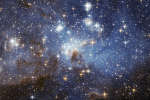 Star Forming Region LH 95
11.03.2008
How do stars form? To better understand this complex and chaotic process, astronomers used the Hubble Space Telescope to image in unprecedented detail the star forming region LH 95 in the nearby Large Magellanic Cloud galaxy.
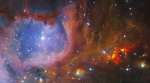 Messier 43
9.07.2015
Often imaged but rarely mentioned, Messier 43 is a large star forming region in its own right. It's just part of the star forming complex of gas and dust that includes the larger, more famous neighboring Messier 42, the Great Orion Nebula.
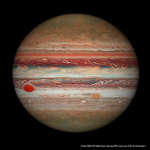 Hubbles Jupiter and the Shrinking Great Red Spot
24.04.2018
What will become of Jupiter's Great Red Spot? Gas giant Jupiter is the solar system's largest world with about 320 times the mass of planet Earth. Jupiter is home to one of the largest and longest lasting storm systems known, the Great Red Spot (GRS), visible to the left.
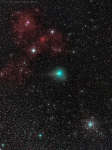 A Charioteer s Comet
28.02.2019
Still racing across planet Earth's night skies, Comet Iwamoto (C/2018 Y1) shares this pretty telescopic field of view with stars and nebulae of northern constellation Auriga, the Charioteer. Captured on February 27, Iwamoto's greenish coma and faint tail appear between a complex of reddish emission nebulae and open star cluster M36 (bottom right).
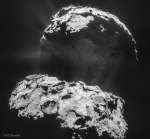 Comet CG Creates Its Dust Tail
11.07.2020
Where do comet tails come from? There are no obvious places on the nuclei of comets from which the jets that create comet tails emanate. One of the best images of emerging jets...
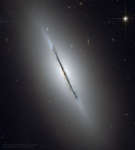 Edge On Galaxy NGC 5866
14.11.2020
Why is this galaxy so thin? Many disk galaxies are just as thin as NGC 5866, pictured here, but are not seen edge-on from our vantage point. One galaxy that is situated edge-on is our own Milky Way Galaxy.
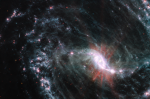 Barred Spiral Galaxy NGC 1365 from Webb
17.02.2023
A mere 56 million light-years distant toward the southern constellation Fornax, NGC 1365 is an enormous barred spiral galaxy about 200,000 light-years in diameter. That's twice the size of our own barred spiral Milky Way.
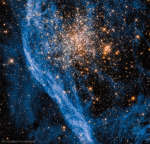 APOD: 2023 February 20 Б NGC 1850: Not Found in the Milky Way
19.02.2023
There is nothing like this ball of stars in our Milky Way Galaxy. This is surprising because, at first glance, this featured image by the Hubble Space Telescope suggests that star cluster NGC 1850...
 Barred Spiral Galaxy NGC 1365 from Webb
12.11.2024
A mere 56 million light-years distant toward the southern constellation Fornax, NGC 1365 is an enormous barred spiral galaxy about 200,000 light-years in diameter. That's twice the size of our own barred spiral Milky Way.
 APOD: 2025 January 14 Б North Star: Polaris and Surrounding Dust
13.01.2025
Why is Polaris called the North Star? First, Polaris is the nearest bright star toward the north spin axis of the Earth. Therefore, as the Earth turns, stars appear to revolve around Polaris, but Polaris itself always stays in the same northerly direction -- making it the North Star.
|
January February March April May June July August September October |
|||||||||||||||||||||||||||||||||||||||||||||||||