
|
You entered: gas
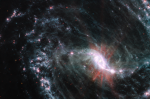 Barred Spiral Galaxy NGC 1365 from Webb
21.01.2026
A mere 56 million light-years distant toward the southern constellation Fornax, NGC 1365 is an enormous barred spiral galaxy about 200,000 light-years in diameter. That's twice the size of our own barred spiral Milky Way.
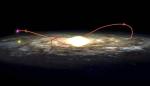 Where a Black Hole Roams
21.09.2001
Black hole candidate XTE J1118+480 is known to roam the halo of our Milky Way Galaxy. This exotic system - thought to be a stellar mass black hole consuming matter from a companion star - was discovered only last year as a flaring celestial x-ray source.
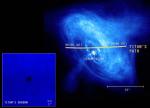 Titan s X Ray
29.04.2004
This June's rare and much heralded transit of Venus will feature our currently brilliant evening star in silhouette, as the inner planet glides across the face of the Sun. But on January 5, 2003 and even rarer transit took place.
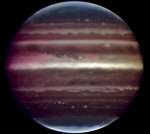 A Sharper View of a Hazy Giant
6.11.2008
This dramatic image of Jupiter is touted as the sharpest picture of the entire gas giant ever taken from the ground. The picture was made using a prototype instrument known as MAD (Multi-conjugate Adaptive optics Demonstrator) mounted on one of the European Southern Observatory's 8-meter diameter Very Large Telescope units in Chile.
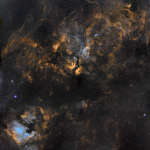 Clouds in Cygnus
30.11.2012
Cosmic clouds of gas and dust drift across this magnificent mosaic covering a 12x12 degree field within the high flying constellation Cygnus. The collaborative skyscape, a combination of broad and narrow band image data presented in the Hubble palette, is anchored by bright, hot, supergiant star Deneb, below center near the left edge.
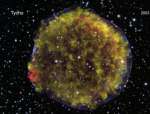 Tychos Supernova Remnant Expands
1.06.2016
What star created this huge expanding puffball? Featured here is the first expansion movie ever created for Tycho's supernova remnant, the result of a stellar explosion first recorded over 400 years ago by the famous astronomer Tycho Brahe.
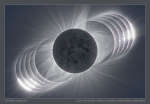 The Big Corona
1.07.2019
Most photographs don't adequately portray the magnificence of the Sun's corona. Seeing the corona first-hand during a total solar eclipse is unparalleled. The human eye can adapt to see coronal features and extent that average cameras usually cannot. Welcome, however, to the digital age.
 APOD: 2020 July 26 Б A Flight through the Hubble Ultra Deep Field
26.07.2020
What would it look like to fly through the distant universe? To find out, a team of astronomers estimated the relative distances to over 5,000 galaxies in one of the most distant fields of galaxies ever imaged: the Hubble Ultra Deep Field (HUDF).
 Centaurus A: Young Blue Star Stream
17.10.2002
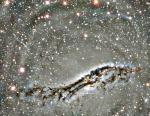
Almost lost in this cosmic jumble of stars, gas and dust is a faint but definite blue arc -- a stream of young stars whose formation was probably triggered as a small dwarf galaxy was torn apart approaching the giant elliptical galaxy Centaurus A.
 Ringed Planet Uranus
15.01.2003
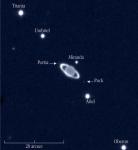
Yes it does look like Saturn, but Saturn is one of only four giant ringed planets in our Solar System. And while Saturn has the brightest rings, this system of rings and moons actually belongs to planet Uranus, imaged here in near-infrared light by the Antu telescope at the ESO Parnal Observatory in Chile.
|
January February March April May June July August September October |
|||||||||||||||||||||||||||||||||||||||||||||||||