
|
You entered: jet
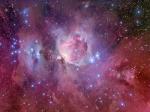 M42: Wisps of the Orion Nebula
20.11.2006
The Great Nebula in Orion, an immense, nearby starbirth region, is probably the most famous of all astronomical nebulas. Here, glowing gas surrounds hot young stars at the edge of an immense interstellar molecular cloud only 1500 light-years away. In the above deep image, faint wisps and sheets of dust and gas are particularly evident.
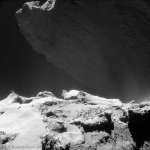 A Cliff Looming on Comet 67P
20.05.2015
What that looming behind this gravel-strewn hill on Comet ChuryumovGerasimenko? A jagged cliff. The unusual double-lobed nucleus of Comet 67P/ChuryumovGerasimenko lends itself to unusual and dramatic vistas, another of which has been captured by the Rosetta spacecraft that arrived at the comet last September.
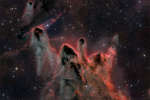 APOD: 2024 July 16 Б Cometary Globules
16.07.2024
What are these unusual interstellar structures? Bright-rimmed, flowing shapes gather near the center of this rich starfield toward the borders of the nautical southern constellations Pupis and Vela. Composed of interstellar gas and dust, the grouping of light-year sized cometary globules is about 1300 light-years distant.
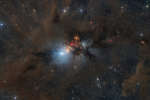 NGC 1333: Stellar Nursery in Perseus
30.01.2026
NGC 1333 is seen in visible light as a reflection nebula, dominated by bluish hues characteristic of starlight reflected by interstellar dust. A mere 1,000 light-years distant toward the heroic constellation Perseus, it lies at the edge of a large, star-forming molecular cloud.
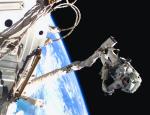 Astronaut at Work
31.05.2000
Did you ever have a day where everything got turned around and you just couldn't tell which way was up? Fortunately, this didn't happen to astronaut James S. Voss on May 21, who spent six hours preparing to fix and upgrade the International Space Station.
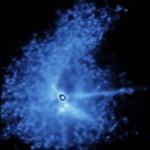 The T Tauri Star Forming System
4.06.2001
What did the Sun look like before there were planets? A prototype laboratory for the formation of low mass stars like our Sun is the T Tauri system, one of the brighter star systems toward the constellation of Taurus. In young systems, gravity causes a gas cloud to condense.
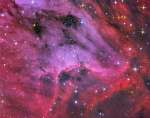 Pelican Nebula Close Up
19.08.2010
The prominent ridge of emission featured in this intensely colorful skyscape is designated IC 5067. Part of a larger emission nebula with a distinctive shape, popularly called The Pelican Nebula, the ridge spans about 10 light-years and follows the curve of the cosmic pelican's head and neck.
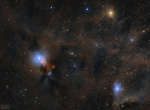 Stardust in the Perseus Molecular cloud
14.01.2017
Clouds of stardust drift through this deep skyscape. The cosmic scene spans nearly 2 degrees across the Perseus molecular cloud some 850 light-years away. A triangle of dusty nebulae reflecting light from embedded stars is captured in the telescopic field of view.
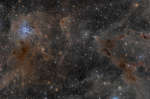 The Iris Nebula in a Field of Dust
12.09.2019
These cosmic dust clouds drift some 1,300 light-years away along the fertile starfields of the constellation Cepheus. The beautiful Iris Nebula, also known as NGC 7023, blossoms at the upper left. Not the only nebula in the sky to evoke the imagery of flowers, its pretty, symmetric form spans about 6 light-years.
 Enceladus Near Saturn
22.03.2006
Some images of Saturn appear surreal. Earlier this year, the robot spacecraft Cassini now orbiting Saturn took this surreal image of the gas giant Saturn, its majestic rings, and its enigmatic world Enceladus all in one frame.
|
January February March April May June July August September |
|||||||||||||||||||||||||||||||||||||||||||||||||