
|
You entered: jet
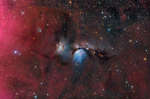 M78 Wide Field
29.12.2017
Interstellar dust clouds and glowing nebulae abound in the fertile constellation of Orion. One of the brightest, M78, is centered in this colorful, wide field view, covering an area north of Orion's belt. At a distance of about 1,500 light-years, the bluish reflection nebula is around 5 light-years across.
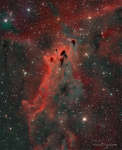 APOD: 2026 April 28 Б CG 30: Cometary Globules
28.04.2026
They're like mountain peaks, but they are forming stars. Bright-rimmed, flowing shapes gather near the center of this rich starfield toward the borders of the nautical southern constellations Puppis and Vela. Composed of interstellar gas and dust, the grouping of light-year sized cometary globules is about 1300 light-years distant.
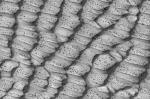 APOD: 2007 August 5- The Dotted Dunes of Mars
5.08.2007
What causes the black dots on dunes on Mars? As spring dawned on the Northern Hemisphere of Mars in 2004, dunes of sand near the poles begin to defrost. Thinner regions of ice typically thaw first revealing sand whose darkness soaks in sunlight and accelerates the thaw.
 Orion Nebula in Oxygen, Hydrogen, and Sulfur
13.07.2004
The Great Nebula in Orion, an immense, nearby starbirth region, is arguably the most famous of all astronomical nebulae. The Orion Nebula, also known as M42, is shown above through ultraviolet and blue filters augmented with three exact colors specifically emitted by hydrogen, oxygen, and sulfur.
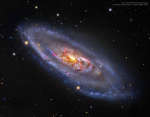 M106: A Spiral Galaxy with a Strange Center
17.03.2019
What's happening at the center of spiral galaxy M106? A swirling disk of stars and gas, M106's appearance is dominated by blue spiral arms and red dust lanes near the nucleus, as shown in the featured image.
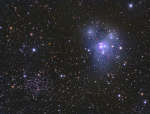 NGC 7129 and NGC 7142
30.08.2019
This wide-field telescopic image looks toward the constellation Cepheus and an intriguing visual pairing of dusty reflection nebula NGC 7129 (right) and open star cluster NGC 7142. The two appear separated by only half a degree on the sky, but they actually lie at quite different distances.
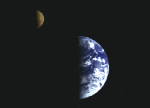 The Earth-Moon System
29.06.1995
A double planet? From 4 million miles away on December 16, 1992, NASA's robot spacecraft Galileo took this picture of the Earth-moon system. The bright, sunlit half of the Earth contrasts strongly with the darker subdued colors of the moon. Our moon is one of the largest moons in the solar system.
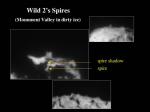 Unusual Spires Found on Comet Wild 2
22.06.2004
How did unusual spires form on comet Wild 2? Close inspection of images taken of Comet Wild 2 by the passing Stardust spacecraft in January show numerous strange pinnacles as long as 100 meters long jutting off the surface. The pinnacles were unexpected - close-ups of other comets and asteroids show no such features.
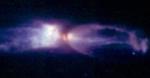 The Rotten Egg Planetary Nebula
1.11.1999
Not all evolving stars eject gas clouds that look like people. OH231.8+4.2 was a star much like our Sun that ran out of nuclear fuel to fuse in its core.
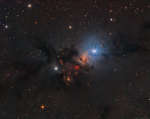 NGC 1333: Stellar Nursery in Perseus
27.03.2019
NGC 1333 is seen in visible light as a reflection nebula, dominated by bluish hues characteristic of starlight reflected by interstellar dust. A mere 1,000 light-years distant toward the heroic constellation Perseus, it lies at the edge of a large, star-forming molecular cloud.
|
January February March April May June July August September |
|||||||||||||||||||||||||||||||||||||||||||||||||