
|
You entered: Moon
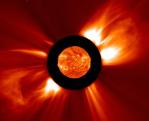 Double Trouble Solar Bubbles
16.05.2002
During April and May, attention has been focused on the western evening sky, presenting its spectacle of bright planets and crescent moons shortly after sunset. Meanwhile, the Sun itself has not been just sinking quietly below the horizon.
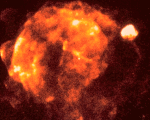 Vela Supernova Remnant in X-ray
12.06.1996
What happens when a star explodes? A huge fireball of hot gas shoots out in all directions. When this gas slams into the existing interstellar medium, it heats up so much it glows in X-rays.
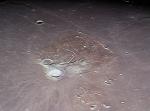 Aristarchus Plateau
13.09.2002
Anchored in the vast lava flows of the Moon's Oceanus Procellarum lies the Aristarchus Plateau. Recorded from a backyard observatory on planet Earth, this sharp, amazingly colorful view nicely captures the geologically diverse area, including the brownish plateau, Aristarchus and Herodotus craters, and the meandering Vallis Schroteri.
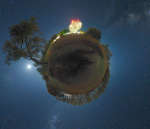 The Planet and the Radio Dish
3.08.2010
What planet is this? Although seemingly something out of The Little Prince, the planet is actually Earth. More specifically, it is a small part of the Earth incorporated into a four image stereographic "Little Planet " projection.
 NGC 5101 and Friends
8.02.2014
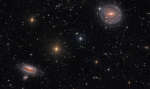
This sharp telescopic field of view holds two bright galaxies. Barred spiral NGC 5101 (top right) and nearly edge-on system NGC 5078 are separated on the sky by about 0.5 degrees or about the apparent width of a full moon.
 The Tarantula Zone
12.06.2014
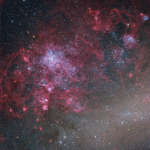
The Tarantula Nebula is more than 1,000 light-years in diameter, a giant star forming region within our neighboring galaxy the Large Magellanic Cloud (LMC). That cosmic arachnid lies toward the upper left in this deep and colorful telescopic view made through broad-band and narrow-band filters.
 Trio Leo
9.05.2015
This popular group is famous as the Leo Triplet - a gathering of three magnificent galaxies in one field of view. Crowd pleasers when imaged with even modest telescopes, they can be introduced individually as NGC 3628 (left), M66 (bottom right), and M65 (top).
 Global Ocean Suspected on Saturns Enceladus
20.09.2015
Do some surface features on Enceladus roll like a conveyor belt? A leading interpretation of images taken of Saturn's most explosive moon indicate that they do. This form of asymmetric tectonic activity, very...
 Perseids and MAGIC
11.08.2022
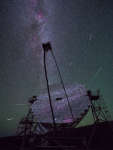
On August 11, 2021 a multi-mirror, 17 meter-diameter MAGIC telescope reflected this starry night sky from the Roque de los Muchachos European Northern Observatory on the Canary Island of La Palma. MAGIC stands for Major Atmospheric Gamma Imaging Cherenkov.
 A Partial Eclipse of an Active Sun
2.11.2022
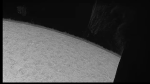
Watch for three things in this unusual eclipse video. First, watch for a big dark circle to approach from the right to block out more and more of the Sun. This dark circle is the Moon, and the video was made primarily to capture this partial solar eclipse last week.
|
January February March April May June July August September October |
|||||||||||||||||||||||||||||||||||||||||||||||||