
|
You entered: Moon
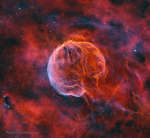 APOD: 2026 January 19 Б CTB 1: The Medulla Nebula
19.01.2026
What powers this unusual nebula? CTB 1 is the expanding gas shell that was left when a massive star toward the constellation of Cassiopeia exploded about 10,000 years ago. The star likely detonated when it ran out of elements, near its core, that could create stabilizing pressure with nuclear fusion.
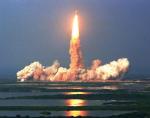 Happy 40th Birthday NASA
1.10.1998
Happy Birthday, NASA! The National Aeronautics and Space Administration officially began operations on October 1, 1958, absorbing its forerunner organization the National Advisory Committee for Aeronautics, NACA. Its landmark achievements in human spaceflight include...
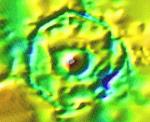 Mjølnir: Impact Crater
10.06.1999
The stark surface of Earth's moon is pocked with large craters, records of a history of fierce bombardment by the solar system's formative debris. It may be difficult to imagine, but nearby planet Earth itself has endured a similar cosmic pounding, though oceans, weathering, and geological
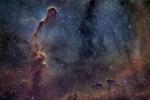 The Elephant s Trunk in IC 1396
18.10.2007
Like an illustration in a galactic Just So Story, the Elephant's Trunk Nebula winds through the emission nebula and young star cluster complex IC 1396, in the high and far off constellation of Cepheus. Of course, this cosmic elephant's trunk is over 20 light-years long.
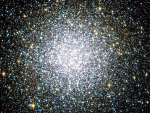 APOD: 2008 April 2- Globular Cluster M55 from CFHT
2.04.2008
The fifty-fifth entry in Charles Messier's catalog, M55 is a large and lovely globular cluster of around 100,000 stars. Only 20,000 light-years away in the constellation Sagittarius, M55 appears to earth-bound observers to be nearly 2/3 the size of the full moon.
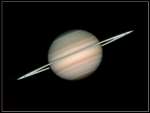 Saturn in View
4.03.2009
Very good telescopic views of Saturn can be expected in the coming days as the ringed planet nears opposition on March 8th, its closest approach to Earth in 2009. Of course, opposition means opposite the Sun in planet Earth's sky - an arrangement that occurs almost yearly for Saturn.
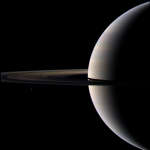 Saturn After Equinox
10.11.2009
The other side of Saturn's ring plane is now directly illuminated by the Sun. For the previous 15 years, the southern side of Saturn and its rings were directly illuminated, but since Saturn's equinox in August, the orientation has reversed.
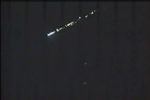 Peekskill Fireball Video: Johnstown
23.01.2011
The Peekskill meteor of 1992 was captured on 16 independent videos and then struck a car. Documented as brighter than the full Moon, the spectacular fireball crossed parts of several USA states during its 40 seconds of glory before landing in New York.
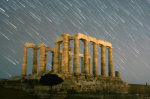 Celestial Trails over Greece
4.05.2011
If you watch the horizon at just the right place and at just the right time, you can witness some spectacular juxtapositions between Earth and sky. In the above video, stars, the Moon, and even a partially eclipsed Sun were recorded rising and setting over photogenic landmarks in Greece.
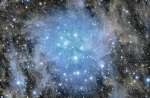 Pleiades Deep Field
21.09.2011
Have you ever seen the Pleiades star cluster? Even if you have, you probably have never seen it like this: all dusty. Perhaps the most famous star cluster on the sky, the bright stars of the Pleiades can be seen without binoculars from even the depths of a light-polluted city.
|
January February March April May June July August September October |
|||||||||||||||||||||||||||||||||||||||||||||||||