
|
You entered: constellation
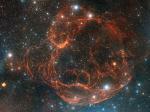 Simeis 147: Supernova Remnant from Palomar
28.11.2005
It's easy to get lost following the intricate filaments in this detailed image of faint supernova remnant Simeis 147. Seen towards the constellation Taurus it covers nearly 3 degrees (6 full moons) on the sky corresponding to a width of 150 light-years at the stellar debris cloud's estimated distance of 3,000 light-years.
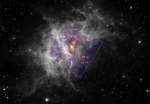 Young Star Cluster Westerlund 2
30.01.2008
Dusty stellar nursery RCW 49 surrounds young star cluster Westerlund 2 in this remarkable composite skyscape from beyond the visible spectrum of light. Infrared data from the Spitzer Space Telescope is shown in black...
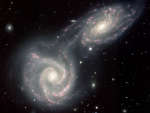 The Colliding Spiral Galaxies of Arp 271
21.07.2008
What will become of these galaxies? Spiral galaxies NGC 5426 and NGC 5427 are passing dangerously close to each other, but each is likely to survive this collision. Most frequently when galaxies collide, a large galaxy eats a much smaller galaxy.
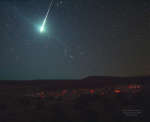 Bright Bolide
11.10.2008
On September 30, a spectacular bolide or fireball meteor surprised a group of amateur astronomers enjoying dark night skies over the Oklahoma panhandle's Black Mesa State Park in the Midwestern US. Flashing past...
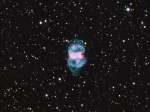 M76 Above and Below
20.11.2008
Also known by the popular name the "Little Dumbbell Nebula", M76 is one of the fainter objects listed in Charles Messier's 18th century Catalog of Nebulae and Star Clusters. Like its better-known namesake M27 (the Dumbbell Nebula), M76 is recognized as a planetary nebula - a gaseous shroud cast off by a dying sunlike star.
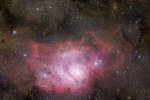 The Lagoon Nebula from GigaGalaxy Zoom
6.10.2009
The large majestic Lagoon Nebula is home for many young stars and hot gas. Spanning 100 light years across while lying only about 5000 light years distant, the Lagoon Nebulae is so big and bright that it can be seen without a telescope toward the constellation of Sagittarius.
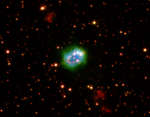 The Necklace Nebula
2.11.2010
The small constellation Sagitta sports this large piece of cosmic jewelry, dubbed the Necklace Nebula. The newly discovered example of a ring-shaped planetary nebula is about 15,000 light-years distant. Its bright ring with pearls of glowing gas is half a light-year across.
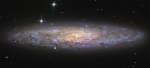 NGC 253: Dusty Island Universe
21.03.2018
Shiny NGC 253 is one of the brightest spiral galaxies visible, and also one of the dustiest. Some call it the Silver Dollar Galaxy for its appearance in small telescopes, or just the Sculptor Galaxy for its location within the boundaries of the southern constellation Sculptor.
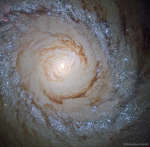 Starburst Galaxy M94 from Hubble
30.07.2022
Why does this galaxy have a ring of bright blue stars? Beautiful island universe Messier 94 lies a mere 15 million light-years distant in the northern constellation of the Hunting Dogs (Canes Venatici).
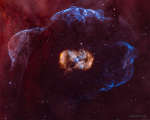 NGC 6164: Dragons Egg Nebula and Halo
25.12.2022
The star at the center created everything. Known as the Dragon's Egg, this star -- a rare, hot, luminous O-type star some 40 times as massive as the Sun -- created not only the complex nebula (NGC 6164) that immediately surrounds it, but also the encompassing blue halo.
|
January February March April May June July August September October |
|||||||||||||||||||||||||||||||||||||||||||||||||