
|
You entered: constellation
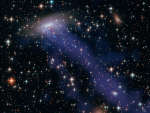 Stripping ESO 137-001
25.08.2018
Spiral galaxy ESO 137-001 hurtles through massive galaxy cluster Abell 3627 some 220 million light years away. The distant galaxy is seen in this colorful Hubble/Chandra composite image through a foreground of the Milky Way's stars toward the southern constellation Triangulum Australe.
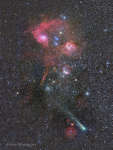 Comet, Clusters, and Nebulae
13.09.2018
Bright enough for binocular viewing Comet 21P / Giacobini-Zinner stands out, even in this deep telephoto mosaic of the star cluster and nebula rich constellation Auriga the Charioteer. On the night of September...
 NGC 2419: Intergalactic Wanderer
13.04.2023
Stars of the globular cluster NGC 2419 are packed into this Hubble Space Telescope field of view toward the mostly stealthy constellation Lynx. The two brighter spiky stars near the edge of the frame are within our own galaxy. NGC 2419 itself is remote though, some 300,000 light-years away.
 The Ghosts of Gamma Cas
28.10.2023
Gamma Cassiopeiae shines high in northern autumn evening skies. It's the brightest spiky star in this telescopic field of view toward the constellation Cassiopeia. Gamma Cas shares the ethereal-looking scene with ghostly interstellar clouds of gas and dust, IC 59 (top left) and IC 63.
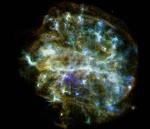 Elements in the Aftermath
26.10.2001
Massive stars spend their brief lives furiously burning nuclear fuel. Through fusion at extreme temperatures and densities surrounding the stellar core, nuclei of light elements like Hydrogen and Helium are combined to heavier elements like Carbon, Oxygen, etc. in a progression which ends with Iron.
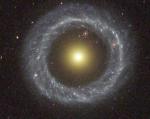 Hoags Object: A Strange Ring Galaxy
15.08.2004
Is this one galaxy or two? This question came to light in 1950 when astronomer Art Hoag chanced upon this unusual extragalactic object. On the outside is a ring dominated by bright blue stars, while near the center lies a ball of much redder stars that are likely much older.
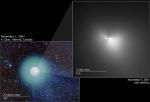 Comet Holmes from the Hubble Space Telescope
28.11.2007
Why did Comet Holmes brighten? The unexpectedly bright Comet 17P/Holmes continues to grace northern skies as a naked-eye addition to the constellation Perseus. Any northern sky enthusiast with a dark sky, a bright curiosity, and a recent sky map should still be able to locate the comet in a few minutes.
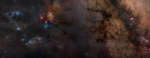 Dark River Wide Field
19.07.2010
A Dark River of dust seems to run from our Galactic Center, then pool into a starfield containing photogenic sky wonders. Scrolling right will reveal many of these objects including (can you find?)...
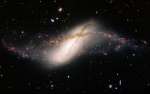 Polar Ring Galaxy NGC 660
10.11.2012
NGC 660 is featured in this cosmic snapshot, a sharp composite of broad and narrow band filter image data from the Gemini North telescope on Mauna Kea. Over 20 million light-years away and swimming within the boundaries of the constellation Pisces, NGC 660's peculiar appearance marks it as a polar ring galaxy.
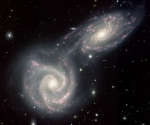 The Colliding Spiral Galaxies of Arp 271
25.08.2013
What will become of these galaxies? Spiral galaxies NGC 5426 and NGC 5427 are passing dangerously close to each other, but each is likely to survive this collision. Typically when galaxies collide, a large galaxy eats a much smaller galaxy.
|
January February March April May June July August September October |
|||||||||||||||||||||||||||||||||||||||||||||||||