
|
You entered: constellation
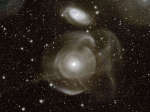 Galaxy NGC 474: Shells and Star Streams
5.01.2014
What's happening to galaxy NGC 474? The multiple layers of emission appear strangely complex and unexpected given the relatively featureless appearance of the elliptical galaxy in less deep images. The cause...
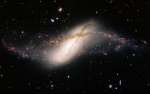 Polar Ring Galaxy NGC 660
7.11.2014
NGC 660 is featured in this cosmic snapshot, a sharp composite of broad and narrow band filter image data from the Gemini North telescope on Mauna Kea. Over 20 million light-years away and swimming within the boundaries of the constellation Pisces, NGC 660's peculiar appearance marks it as a polar ring galaxy.
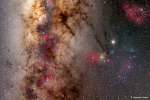 A Scorpius Sky Spectacular
6.04.2019
If Scorpius looked this good to the unaided eye, humans might remember it better. Scorpius more typically appears as a few bright stars in a well-known but rarely pointed out zodiacal constellation. To get a spectacular image like this, though, one needs a good camera, color filters, and a digital image processor.
 Carina Nebula Panorama from Hubble
22.06.2019
How do violent stars affect their surroundings? To help find out, astronomers created a 48-frame high-resolution, controlled-color panorama of the center of the Carina Nebula, one of the largest star forming regions on the night sky. The featured image, taken in 2007, was the most detailed image of the Carina Nebula yet taken.
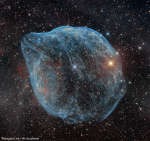 Sharpless 308: The Dolphin-Head Nebula
20.10.2021
Blown by fast winds from a hot, massive star, this cosmic bubble is huge. Cataloged as Sharpless 2-308 it lies some 5,000 light-years away toward the constellation of the Big Dog (Canis Major) and covers slightly more of the sky than a Full Moon.
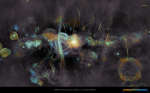 The Galactic Center in Radio from MeerKAT
1.02.2022
What's happening at the center of our galaxy? It's hard to tell with optical telescopes since visible light is blocked by intervening interstellar dust. In other bands of light, though, such as radio, the galactic center can be imaged and shows itself to be quite an interesting and active place.
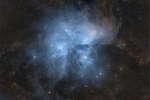 Messier 45: The Daughters of Atlas and Pleione
4.01.2023
Hurtling through a cosmic dust cloud a mere 400 light-years away, the lovely Pleiades or Seven Sisters open star cluster is well-known for its striking blue reflection nebulae. It lies in the night sky toward the constellation Taurus and the Orion Arm of our Milky Way galaxy.
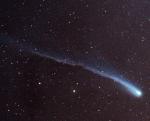 Comet Ikeya Zhang Brightens
6.03.2002
In the last week, Comet Ikeya-Zhang has become bright enough to be just visible to the unaided eye. Based on its present activity, observers are optimistic that Ikeya-Zhang will become substantially brighter. This composite...
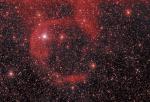 Alpha Cam: Runaway Star
23.11.2006
Runaway stars are massive stars traveling rapidly through interstellar space. Like a ship plowing through cosmic seas, runaway star Alpha Cam has produced this graceful arcing bow wave or bow shock - moving at over 60 kilometers per second and compressing the interstellar material in its path.
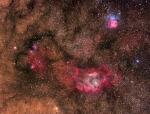 Sagittarius Triplet
4.08.2007
These three bright nebulae are often featured in telescopic tours of the constellation Sagittarius and the crowded starfields of the central Milky Way. In fact, 18th century cosmic tourist Charles Messier cataloged two of them; M8, the nebula below and right of center, and colorful M20 at the upper right.
|
January February March April May June July August September October |
|||||||||||||||||||||||||||||||||||||||||||||||||