
|
You entered: galaxies
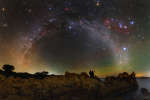 A Night Sky Vista from Sardinia
21.10.2020
How many famous sky objects can you find in this image? The featured dark sky composite combines over 60 exposures spanning over 220 degrees to create a veritable menagerie of night sky wonders. Visible...
 Saturn: 1993 2022
19.08.2022
Saturn is the most distant planet of the Solar System easily visible to the unaided eye. With this extraordinary, long-term astro-imaging project begun in 1993, you can follow the ringed gas giant for one Saturn year as it wanders once around the ecliptic plane, finishing a single orbit around the Sun by 2022.
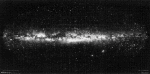 7,000 Stars and the Milky Way
17.05.1997
This panorama view of the sky is really a drawing. It was made in the 1940s under the supervision of astronomer Knut Lundmark at the Lund Observatory in Sweden. To create the picture, draftsmen...
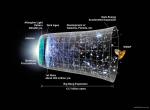 Inflating the Universe
23.03.2006
The Universe is expanding gradually now. But its initial expansion was almost impossibly rapid as it likely grew from quantum scale fluctuations in a trillionth of a second. In fact, this cosmological scenario, known as Inflation, is now reported to be further quantified by an analysis of three years of data from the WMAP spacecraft.
 Chandra Resolves the Hard X Ray Background
14.01.2000
It is everywhere but nobody knew why. In every direction at all times, the sky glows in X-rays. The X-ray background phenomenon was discovered over 35 years ago, soon after the first X-ray satellites were launched, and has since gone unexplained.
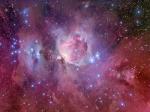 M42: Wisps of the Orion Nebula
20.11.2006
The Great Nebula in Orion, an immense, nearby starbirth region, is probably the most famous of all astronomical nebulas. Here, glowing gas surrounds hot young stars at the edge of an immense interstellar molecular cloud only 1500 light-years away. In the above deep image, faint wisps and sheets of dust and gas are particularly evident.
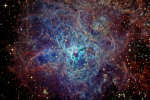 The Cosmic Web of the Tarantula Nebula
11.11.2008
First cataloged as a star, 30 Doradus is actually an immense star forming region in nearby galaxy The Large Magellanic Cloud. The region's spidery appearance is responsible for its popular name, the Tarantula nebula, except that this tarantula is about 1,000 light-years across, and 180,000 light-years away in the southern constellation Dorado.
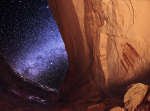 Milky Way Over Ancient Ghost Panel
19.05.2010
Long before Stonehenge was built, well before the Dead Sea Scrolls were written, ancient artists painted life-sized figures on canyon walls in Utah, USA -- but why? Nobody is sure. The entire panel of figures...
 The Big Dipper
24.06.2011
The best known asterism in northern skies, The Big Dipper is easy to recognize, though some might see The Plough. Either way, the star names and the familiar outlines will appear in this thoughtfully composed 24 frame mosaic when you slide your cursor over the image.
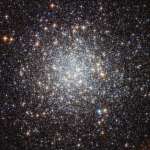 Messier 9 Close Up
23.03.2012
Renown 18th century astronomer Charles Messier described this 9th entry in his famous astronomical catalog as "Nebula, without star, in the right leg of Ophiuchus ...". But Messier 9 (M9) does have stars, known to modern astronomers as a globular cluster of over 300,000 stars within a diameter of about 90 light-years.
|
January February March April May June July August September October |
|||||||||||||||||||||||||||||||||||||||||||||||||