
|
You entered: galaxies
 Messier 2
19.12.2024
After the Crab Nebula, this giant star cluster is the second entry in 18th century astronomer Charles Messier's famous list of things that are not comets. M2 is one of the largest globular star clusters now known to roam the halo of our Milky Way galaxy.
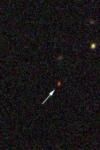 High Redshift Quasars
11.12.1998
Each red speck indicated above is a powerful quasar estimated to be over 100 times brighter than a galaxy. Yet in these Sloan Digital Sky Survey discovery images the quasars appear faint because they are extremely distant.
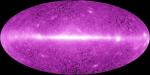 The Gamma Ray Sky
12.01.2002
What if you could see gamma rays? If you could, the sky would seem to be filled with a shimmering high-energy glow from the most exotic and mysterious objects in the Universe.
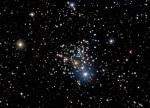 NGC 2266: Old Cluster in the New General Catalog
1.06.2002
The New General Catalog of star clusters and nebulae really isn't so new. In fact, it was published in 1888 - an attempt by J. L. E. Dreyer to consolidate the work of astronomers William, Caroline, and John Herschel along with others into a useful single, complete catalog of astronomical discoveries and measurements.
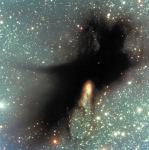 BHR 71: Stars, Clouds, and Jets
27.01.2003
What is happening to molecular cloud BHR 71? Quite possible, a binary star system is forming inside. Most stars in our Galaxy are part of binary star systems, but few have ever been seen in formation.
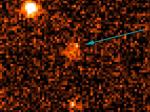 GRB Fireball Persists
17.09.1997
It's still there. The optical counterpart to the instantly famous gamma-ray burst (GRB) that occurred last February 28th has faded - but not completely. The astronomical community had waited patiently for months...
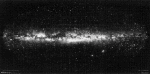 7,000 Stars And The Milky Way
23.05.1998
This panorama view of the sky is really a drawing. It was made in the 1950s under the supervision of astronomer Knut Lundmark at the Lund Observatory in Sweden. To create the picture, draftsmen...
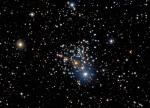 NGC 2266: Old Cluster in the New General Catalog
19.03.2005
The New General Catalog of star clusters and nebulae really isn't so new. In fact, it was published in 1888 - an attempt by J. L. E. Dreyer to consolidate the work of astronomers William, Caroline, and John Herschel along with others into a useful single, complete catalog of astronomical discoveries and measurements.
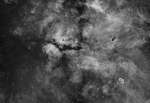 Central Cygnus Skyscape
27.10.2009
In cosmic brush strokes of glowing hydrogen gas, this beautiful skyscape unfolds across the plane of our Milky Way Galaxy and the center of the northern constellation Cygnus the Swan. Recorded from a premier remote observatory site (ROSA) in southern France, the image spans about 6 degrees.
 The Eagle and The Swan
31.05.2013
The Eagle Nebula and the Swan Nebula span this broad starscape, a telescopic view of the Sagittarius spiral arm toward the center of our Milky Way galaxy. The Eagle, also known as M16, is left, above center, and the Swan, or M17 at the lower right.
|
January February March April May June July August September October |
|||||||||||||||||||||||||||||||||||||||||||||||||