
|
You entered: star
 APOD: 2024 April 3 Б Unusual Nebula Pa 30
3.04.2024
What created this unusual celestial firework? The nebula, dubbed Pa 30, appears in the same sky direction now as a bright "guest star" did in the year 1181. Although Pa 30's filaments look...
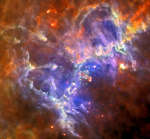 Inside the Eagle Nebula
3.02.2012
In 1995, a now famous picture from the Hubble Space Telescope featured Pillars of Creation, star forming columns of cold gas and dust light-years long inside M16, the Eagle Nebula. This remarkable false-color composite image revisits the nearby stellar nursery with image data from the orbiting Herschel Space Observatory and XMM-Newton telescopes.
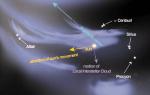 The Local Interstellar Cloud
10.02.2002
The stars are not alone. In the disk of our Milky Way Galaxy about 10 percent of visible matter is in the form of gas, called the interstellar medium (ISM). The ISM is not uniform, and shows patchiness even near our Sun.
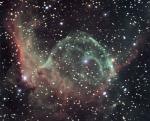 NGC 2359: Thor s Helmet
5.12.2002
NGC 2359 is a striking emission nebula with an impressive popular name - Thor's Helmet. Sure, its suggestive winged appearance might lead some to refer to it as the "duck nebula", but if you were a nebula which name would you choose?
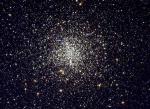 M4: The Closest Known Globular Cluster
23.05.2000
M4 is a globular cluster visible in dark skies about one degree west of the bright star Antares in the constellation Scorpius. M4 is perhaps the closest globular cluster at 7000 light years, meaning that we see M4 only as it was 7000 years ago, near the dawn of recorded human history.
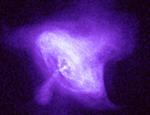 The Crab Nebula in X Rays
29.09.1999
Why does the Crab Nebula still glow? In the year 1054 A.D. a supernova was observed that left a nebula that even today glows brightly in every color possible, across the entire electromagnetic spectrum. At the nebula's center is an ultra-dense neutron star that rotates 30 times a second.
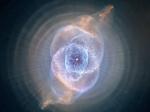 The Cats Eye Nebula from Hubble
13.05.2007
Staring across interstellar space, the alluring Cat's Eye nebula lies three thousand light-years from Earth. A classic planetary nebula, the Cat's Eye (NGC 6543) represents a final, brief yet glorious phase in the life of a sun-like star.
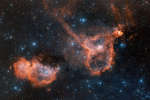 The Heart and Soul Nebulas
14.09.2008
Is the heart and soul of our Galaxy located in Cassiopeia? Possibly not, but that is where two bright emission nebulas nicknamed Heart and Soul can be found. The Heart Nebula, officially dubbed IC 1805 and visible in the above zoomable view on the right, has a shape reminiscent of a classical heart symbol.
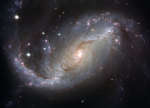 Spiral Galaxy NGC 1672 from Hubble
13.05.2012
Many spiral galaxies have bars across their centers. Even our own Milky Way Galaxy is thought to have a modest central bar. Prominently barred spiral galaxy NGC 1672, pictured above, was captured in spectacular detail in image taken by the orbiting Hubble Space Telescope.
 APOD: 2025 May 27 Б Zeta and Rho Ophiuchi with Milky Way
27.05.2025
Behold one of the most photogenic regions of the night sky, captured impressively. Featured, the band of our Milky Way Galaxy runs diagonally along the bottom-left corner, while the colorful Rho Ophiuchi cloud complex is visible just right of center and the large red circular Zeta Ophiuchi Nebula appears near the top.
|
January February March April May June July August September October |
|||||||||||||||||||||||||||||||||||||||||||||||||