
|
You entered: star
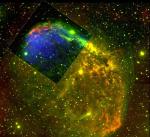 NGC 6888: X Rays in the Wind
16.10.2003
NGC 6888, also known as the Crescent Nebula, is a cosmic bubble of interstellar gas about 25 light-years across. Created by winds from the bright, massive star seen near the center of this composite image, the shocked filaments of gas glowing at optical wavelengths are represented in green and yellowish hues.
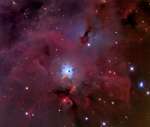 NGC 1999: South of Orion
24.02.2011
South of the large star-forming region known as the Orion Nebula, lies bright blue reflection nebula NGC 1999. Also at the edge of the Orion molecular cloud complex some 1,500 light-years distant, NGC 1999's illumination is provided by the embedded variable star V380 Orionis.
 APOD: 2020 August 26 Б Cygnus Skyscape
26.08.2020
In brush strokes of interstellar dust and glowing hydrogen gas, this beautiful skyscape is painted across the plane of our Milky Way Galaxy near the northern end of the Great Rift and the constellation Cygnus the Swan.
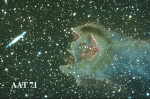 CG4: A Ruptured Cometary Globule
28.12.1996
The odd looking "creature" to the right of center in the above photo is a gas cloud known as a cometary globule. This globule, however, has ruptured. Cometary globules are typically characterized by dusty heads and elongated tails.
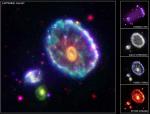 Cartwheel Of Fortune
18.01.2006
By chance, a collision of two galaxies has created a surprisingly recognizable shape on a cosmic scale - The Cartwheel Galaxy. The Cartwheel is part of a group of galaxies about 400 million light years away in the constellation Sculptor (two smaller galaxies in the group are visible below and left).
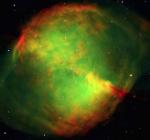 M27: Not A Comet
2.03.2002
While searching the skies above 18th century France for comets, astronomer Charles Messier diligently recorded this object as number 27 on his list of things which are definitely not comets. So what is it?
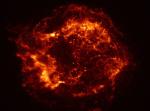 Chandras First Light: Cassiopeia A
27.08.1999
Cosmic wreckage from the detonation of a massive star is the subject of this official first image from NASA's Chandra X-ray Observatory. The supernova remnant, known as Cassiopeia A, was produced when a star exploded around 300 years ago in this northern sky constellation.
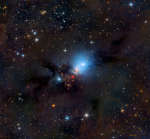 NGC 1333 Stardust
6.03.2014
NGC 1333 is seen in visible light as a reflection nebula, dominated by bluish hues characteristic of starlight reflected by dust. A mere 1,000 light-years distant toward the heroic constellation Perseus, it lies at the edge of a large, star-forming molecular cloud.
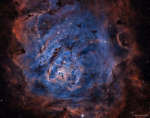 The Lagoon Nebula in Hydrogen Sulfur and Oxygen
5.01.2016
The majestic Lagoon Nebula is filled with hot gas and the home for many young stars. Spanning 100 light years across while lying only about 5000 light years distant, the Lagoon Nebula is so big and bright that it can be seen without a telescope toward the constellation of the Archer (Sagittarius).
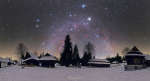 A Northern Winter Sky Panorama
24.12.2019
What stars shine in Earth's northern hemisphere during winter? The featured image highlights a number of bright stars visible earlier this month. The image is a 360-degree horizontal-composite panorama of 66 vertical frames taken consecutively with the same camera and from the same location at about 2:30 am.
|
January February March April May June July August September October |
|||||||||||||||||||||||||||||||||||||||||||||||||