
|
You entered: planets
 The Map Of Eros
26.10.2000
This map of Eros was constructed from a mosaic of images recorded by the NEAR Shoemaker spacecraft, currently orbiting the 40 x 14 x 14 kilometer asteroid. A simple cylindrical projection of an irregularly shaped world, the map's individual images don't always match up at the edges.
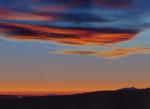 Mercury on the Horizon
12.04.2003
Have you ever seen the planet Mercury? Because Mercury orbits so close to the Sun, it never wanders far from the Sun in Earth's sky. If trailing the Sun, Mercury will be visible low on the horizon for only a short while before sunset.
 The Martian Spring
4.11.1996
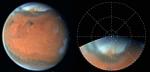
As spring comes to the northern latitudes of Mars, increased solar heating brings warmth and a change in the weather. The winds produced by the large temperature differences between the receding polar...
 A Late Leonid from a Sparse Shower
25.11.2003
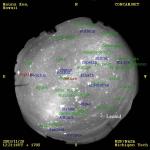
The 2003 Leonids Meteor Shower contained relatively few meteors. As expected and unlike the last few years, the Earth just did not pass through any dense particle streams left over by the Sun-orbiting Comet Tempel-Tuttle.
 Solstice Celebration
20.06.2004
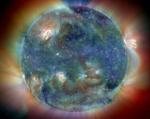
Season's greetings! Today or tomorrow, depending on your time zone, the Sun reaches its northernmost point in planet Earth's sky marking a season change and the first solstice of the year 2004. In celebration, consider this delightfully detailed, brightly colored image of the active Sun.
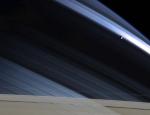 Mimas, Rings, and Shadows
2.12.2004
Caught in sunlight, icy moon Mimas shines above a broad shadow across gas giant Saturn. In this remarkable image from the Cassini spacecraft, tiny Mimas is at the upper right. The broad shadow across...
 Red Saturn
10.02.2005
This strange, false-color image of otherwise familiar planet Saturn shows temperature changes based on thermal infrared emission in the gas giant's atmosphere and rings. Recorded from the Keck I telescope on Mauna Kea, the sharp, ground-based picture of Saturn's southern hemisphere is a mosaic of 35 images.
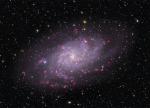 M33: Spiral Galaxy in Triangulum
14.09.2006
The small, northern constellation Triangulum harbors this magnificent face-on spiral galaxy, M33. Its popular names include the Pinwheel Galaxy or just the Triangulum Galaxy. M33 is over 50,000 light-years in diameter, third largest in the Local Group of galaxies after the Andromeda Galaxy (M31), and our own Milky Way.
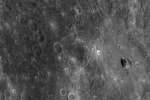 Unknown Dark Material on Mercury
6.07.2009
What is that strange material on Mercury? When flying by Mercury last October, the robotic MESSENGER spacecraft imaged much of the solar system's innermost planet in unprecedented detail. As common in science, new data bring new mysteries.
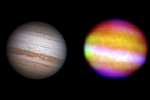 Jupiter from the Stratosphere
3.06.2010
SOFIA, the Stratospheric Observatory for Infrared Astronomy, captured its "first light" images on May 26, from an altitude of 35,000 feet. While flying above most of planet Earth's infrared-absorbing water vapor, SOFIA's premier infrared views of the cosmos included this remarkable false-color image (right panel) of Jupiter.
|
January February March April May June July August September October |
|||||||||||||||||||||||||||||||||||||||||||||||||