
|
You entered: planets
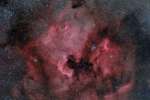 North America and the Pelican
3.09.2013
Here lie familiar shapes in unfamiliar locations. On the left is an emission nebula cataloged as NGC 7000, famous partly because it resembles our fair planet's continent of North America. The emission region to the right of the North America Nebula is IC 5070, also known for its suggestive outlines as the Pelican Nebula.
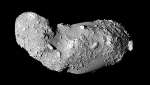 The Missing Craters of Asteroid Itokawa
9.02.2014
Where are the craters on asteroid Itokawa? Missing -- unexpectedly. The Japanese robot probe Hayabusa approached the Earth-crossing asteroid in 2005 and returned pictures showing a surface unlike any other Solar System body yet photographed -- a surface possibly devoid of craters.
 Aurora Dog over Alaska
29.04.2014
Sometimes it is hard to believe what you see in the sky. While leading his annual aurora tour last month near Fairbanks in central Alaska, astrophotographer John Chumack and his company saw a most unusual aurora. This bright aurora appeared to change into the shape of a jumping dog, complete with a curly tail.
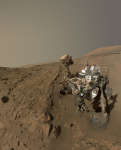 Martian Anniversary Selfie
27.06.2014
June 24th marked the first full Martian year of the Curiosity Rover's exploration of the surface of the Red Planet. That's 687 Earth days or 669 sols since its landing on August 5, 2012.
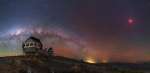 Eclipsed in Southern Skies
1.10.2015
This stunning panorama in southern skies was recorded on the colorful night of September 27/28 from Carngegie Las Campanas Observatory. A diffuse glow and dark rifts of the central Milky Way hang over domes of the twin 6.5 meter Magellan telescopes. But most eye-catching is the deep red glow of the Moon.
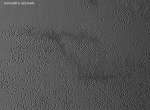 Unusual Pits Discovered on Pluto
25.11.2015
Why are there unusual pits on Pluto? The indentations were discovered during the New Horizons spacecraft's flyby of the dwarf planet in July. The largest pits span a kilometer across and dip tens...
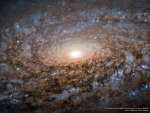 In the Center of Spiral Galaxy NGC 3521
30.11.2015
This huge swirling mass of stars, gas, and dust occurs near the center of a nearby spiral galaxy. Gorgeous spiral NGC 3521 is a mere 35 million light-years distant, toward the constellation Leo. Spanning some 50,000 light-years, its central region is shown in this dramatic image, constructed from data from the Hubble Space Telescope.
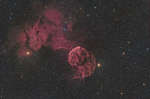 Sharpless 249 and the Jellyfish Nebula
23.03.2018
Normally faint and elusive, the Jellyfish Nebula is caught in this alluring telescopic image. Centered in the scene it's anchored right and left by two bright stars, Mu and Eta Geminorum, at the foot of the celestial twin. The Jellyfish Nebula is the brighter arcing ridge of emission with dangling tentacles.
 Fermi Science Playoffs
8.06.2018
NASA's Fermi Gamma-ray Space Telescope was launched into orbit on June 11th, 2008. Its instruments detect gamma-rays -- light that is thousands to hundreds of billions of times more energetic than what we see with our eyes.
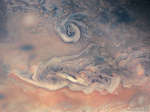 Swirls and Colors on Jupiter from Juno
21.11.2018
What creates the colors in Jupiter's clouds? No one is sure. The thick atmosphere of Jupiter is mostly hydrogen and helium, elements which are colorless at the low temperatures of the Jovian cloud tops.
|
January February March April May June July August September October |
|||||||||||||||||||||||||||||||||||||||||||||||||