
|
You entered: planets
 Jupiter s Clouds from New Horizons
15.10.2007
The New Horizons spacecraft took some stunning images of Jupiter earlier this year while on the way out to Pluto. Famous for its Great Red Spot, Jupiter is also known for its regular, equatorial cloud bands, visible through even modest sized telescopes.
 An Avalanche on Mars
11.03.2008
What caused this sudden cloud of dust on Mars? An avalanche! The first avalanche imaged in progress on another planet was recorded last month on Mars by NASA's robotic Mars Reconnaissance Orbiter. Visible...
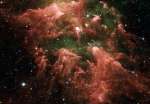 Sculpting the South Pillar
13.03.2008
Eta Carinae, one of the most massive and unstable stars in the Milky Way Galaxy, has a profound effect on its environment. Found in the the South Pillar region of the Carina Nebula, these...
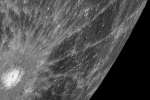 A Spectacular Rayed Crater on Mercury
3.11.2008
Why does Mercury have so many rayed craters? No one is sure. The robotic MESSENGER spacecraft that is taking unprecedented images as it swoops past the innermost planet has provided dramatic confirmation that Mercury has more rayed craters than Earth's Moon.
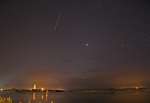 Shuttle and Meteor
14.08.2009
This early morning skyscape was captured last week on August 4th, looking northeast across calm waters in the Turn Basin at NASA's Kennedy Space Center. In a striking contrast in motion, the space...
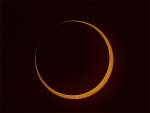 Cape York Annular Eclipse
11.05.2013
This week the shadow of the New Moon fell on planet Earth, crossing Queensland's Cape York in northern Australia ... for the second time in six months. On the morning...
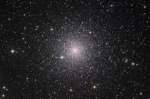 Globular Star Cluster NGC 6752
5.07.2013
Some 13,000 light-years away toward the southern constellation Pavo, the globular star cluster NGC 6752 roams the halo of our Milky Way galaxy. Over 10 billion years old, NGC 6752 follows clusters Omega Centauri and 47 Tucanae as the third brightest globular in planet Earth's night sky.
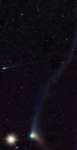 Comets and Bright Star
6.01.2016
This timely, telescopic, two panel mosaic spans about 10 full moons across planet Earth's predawn skies. Recorded as the year began from Tenerife, Canary Islands, near the top of the frame are the faint coma and tail of Comet Borrelly (P/19).
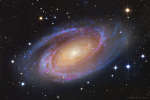 Bright Spiral Galaxy M81
17.09.2017
One of the brightest galaxies in planet Earth's sky is similar in size to our Milky Way Galaxy: big, beautiful M81. This grand spiral galaxy can be found toward the northern constellation of the Great Bear (Ursa Major).
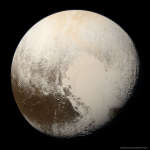 Pluto in True Color
10.09.2019
What color is Pluto, really? It took some effort to figure out. Even given all of the images sent back to Earth when the robotic New Horizons spacecraft sped past Pluto in 2015, processing these multi-spectral frames to approximate what the human eye would see was challenging.
|
January February March April May June July August September October |
|||||||||||||||||||||||||||||||||||||||||||||||||