
|
You entered: planets
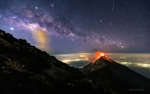 A Volcano of Fire under a Milky Way of Stars
27.05.2019
Sometimes it's hard to decide which is more impressive -- the land or the sky. On the land of the featured image, for example, the Volcano of Fire (VolcАn de Fuego) is seen erupting topped by red-hot, wind-blown ash and with streams of glowing lava running down its side.
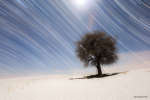 Star Trails of the North and South
12.02.2020
What divides the north from the south? It all has to do with the spin of the Earth. On Earth's surface, the equator is the dividing line, but on Earth's sky, the dividing line is the Celestial Equator -- the equator's projection onto the sky.
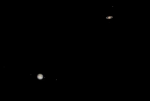 Jupiter and Saturn Great Conjunction: The Movie
30.12.2020
Yes, but have you seen a movie of Jupiter and Saturn's Great Conjunction? The featured time-lapse video was composed from a series of images taken from Thailand and shows the two giant planets as they angularly passed about a tenth of a degree from each other.
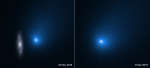 Interstellar Comet 2I Borisov
5.03.2022
From somewhere else in the Milky Way galaxy, Comet 2I/Borisov was just visiting the Solar System. Discovered by amateur astronomer Gennady Borisov on August 30, 2019, the first known interstellar comet is seen in these two Hubble Space Telescope images from November and December 2019.
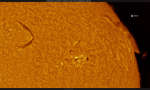 Filaprom on the Western Limb
24.06.2022
A solar filament is an enormous stream of incandescent plasma suspended above the active surface of the Sun by looping magnetic fields. Seen against the solar disk it looks dark only because it's a little cooler, and so slightly dimmer, than the solar photosphere.
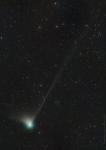 Comet 2022 E3 ZTF
24.12.2022
Comet C/2022 E3 (ZTF) was discovered by astronomers using the wide-field survey camera at the Zwicky Transient Facility this year in early March. Since then the new long-period comet has brightened substantially and is now sweeping across the northern constellation Corona Borealis in predawn skies.
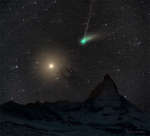 APOD: 2023 February 13 Б Comet ZTF and Mars
13.02.2023
No, Comet ZTF is not going to hit Mars. Nicknamed the Green Comet for its bright green coma, C/2022 E3 (ZTF) did, however, pass almost in front of the much-more distant planet a few days ago, very near in time to when the featured picture was taken.
 The SAR and the Milky Way
11.11.2023
This broad, luminous red arc was a surprising visitor to partly cloudy evening skies over northern France. Captured extending toward the zenith in a west-to-east mosaic of images from November 5, the faint atmospheric ribbon of light is an example of a Stable Auroral Red (SAR) arc.
 Alpha Centauri: The Closest Star System
26.05.1996
The closest star system to the Sun is the Alpha Centauri system. Of the three stars in the system, the dimmest -- called Proxima Centauri -- is actually the nearest star. The bright stars Alpha Centauri...
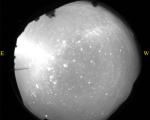 Zodiacal Light and the False Dawn
15.09.2002
An unusual triangle of light will be particularly bright near the eastern horizon before sunrise during the next two months for observers in Earth's northern hemisphere. Once considered a false dawn, this triangle of light is actually Zodiacal Light, light reflected from interplanetary dust particles.
|
January February March April May June July August September October |
|||||||||||||||||||||||||||||||||||||||||||||||||