
|
You entered: planets
 A Blue Hour Full Moon
26.08.2021
Nature photographers and other fans of planet Earth always look forward to the blue hour. That's the transition in twilight, just before sunrise or after sunset, when the Sun is below the horizon but land and sky are still suffused with a beautiful blue light.
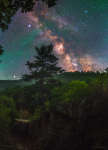 Firefly Milky Way over Russia
6.09.2021
It started with a pine tree. The idea was to photograph a statuesque pine in front of the central band of our Milky Way Galaxy. And the plan, carried out two months ago, was successful -- they both appear prominently. But the resulting 3-frame panorama captured much more.
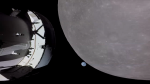 Earthset from Orion
23.11.2022
Eight billion people are about to disappear in this snapshot from space. Taken on November 21, the sixth day of the Artemis 1 mission, their home world is setting behind the Moon's bright edge as viewed by an external camera on the outbound Orion spacecraft.
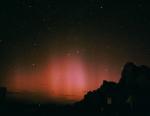 Aurora In West Texas Skies
15.09.2000
The aurora borealis, or northern lights, are not a common sight in the southwestern United States. But a strong solar coronal mass ejection in early August triggered geomagnetic storms and aurora which were widely reported, even under west Texas skies.
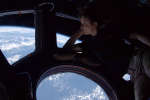 Home from Above
15.11.2010
There's no place like home. Peering out of the windows of the International Space Station (ISS), astronaut Tracy Caldwell Dyson takes in the planet on which we were all born, and to which she would soon return.
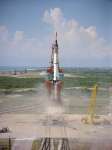 50 Years Ago: Freedom 7 Flies
5.05.2011
Fifty years ago, near the dawn of the space age, NASA controllers "lit the candle" and sent Mercury astronaut Alan Shepard arcing into space atop a Redstone rocket. His cramped space capsule was dubbed Freedom 7.
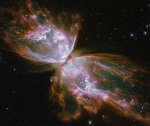 The Butterfly Nebula from Hubble
13.11.2011
Few butterflies have a wingspan this big. The bright clusters and nebulae of planet Earth's night sky are often named for flowers or insects, and NGC 6302 is no exception. With an estimated...
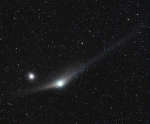 Comet Garradd and M92
4.02.2012
Sweeping slowly through the constellation Hercules, Comet Garradd (C2009/P1) passed with about 0.5 degrees of globular star cluster M92 on February 3. Captured here in its latest Messier moment, the steady performer remains just below naked-eye visibility with a central coma comparable in brightness to the dense, well-known star cluster.
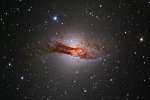 Centaurus A
4.04.2012
What's the closest active galaxy to planet Earth? That would be Centaurus A, only 11 million light-years distant. Spanning over 60,000 light-years, the peculiar elliptical galaxy is also known as NGC 5128.
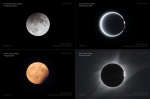 All the Eclipses of 2017
7.12.2017
As seen from planet Earth, all the lunar and solar eclipses of 2017 are represented at the same scale in these four panels. The year's celestial shadow play was followed through four different countries by one adventurous eclipse chaser.
|
January February March April May June July August September October |
|||||||||||||||||||||||||||||||||||||||||||||||||