
|
You entered: planets
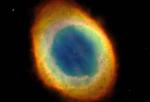 M57: The Ring Nebula
4.07.2004
Except for the rings of Saturn, the Ring Nebula (M57) is probably the most famous celestial band. This planetary nebula's simple, graceful appearance is thought to be due to perspective -- our view from planet Earth looking straight into what is actually a barrel-shaped cloud of gas shrugged off by a dying central star.
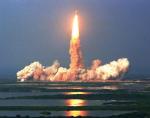 Happy 40th Birthday NASA
1.10.1998
Happy Birthday, NASA! The National Aeronautics and Space Administration officially began operations on October 1, 1958, absorbing its forerunner organization the National Advisory Committee for Aeronautics, NACA. Its landmark achievements in human spaceflight include...
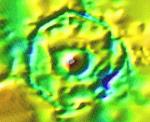 Mjølnir: Impact Crater
10.06.1999
The stark surface of Earth's moon is pocked with large craters, records of a history of fierce bombardment by the solar system's formative debris. It may be difficult to imagine, but nearby planet Earth itself has endured a similar cosmic pounding, though oceans, weathering, and geological
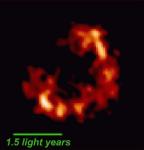 Supernova Remnant In M82
16.12.1999
This false-color radio wavelength picture of an expanding stellar debris cloud is the product of one of the largest radio astronomy experiments ever. Combining the output of 20 radio telescopes scattered around planet Earth...
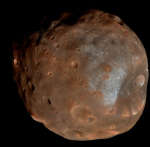 Phobos: Doomed Moon of Mars
14.04.2008
This moon is doomed. Mars, the red planet named for the Roman god of war, has two tiny moons, Phobos and Deimos, whose names are derived from the Greek for Fear and Panic. These...
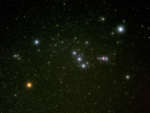 Camera Orion
15.10.2008
Orion, the Hunter, is one of the most easily recognizable constellations in planet Earth's night sky. But Orion's stars and nebulas don't look quite as colorful to the eye as they...
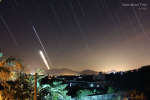 A Fading Moonset Over Hong Kong
15.12.2009
Do stars appear dimmer when nearer the horizon? Yes -- atmospheric air absorbs and reradiates light, so that the greater the airmass through which one peers, the fainter an object will appear. Pictured above in a multi-frame image, stars, the planet Jupiter, and even the Moon show the horizon-dimming effects of Earth's nearly-transparent atmosphere.
 Watch Jupiter Rotate
24.01.2010
What would it be like to coast by Jupiter and watch it rotate? This was just the experience of the New Horizons spacecraft as it approached and flew by Jupiter in 2007. Clicking on the image will bring up a movie of what the robotic spacecraft saw.
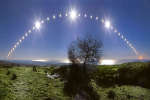 Tyrrhenian Sea and Solstice Sky
21.12.2010
Today the solstice occurs at 23:38 Universal Time, the Sun reaching its southernmost declination in planet Earth's sky. Of course, the December solstice marks the beginning of winter in the northern hemisphere and summer in the south.
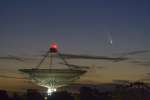 PanSTARRS over Parkes
9.03.2013
Sweeping quickly through southern skies on March 5, Comet PanSTARRS (C/2011 L4) follows the Sun toward the western horizon in this twilight scene. In the foreground is Australia's CSIRO Parkes Radio Telescope, a 64 meter wide steerable dish that is no stranger to the space age exploration of comets.
|
January February March April May June July August September October |
|||||||||||||||||||||||||||||||||||||||||||||||||