
|
You entered: ring
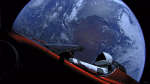 Car Orbiting Earth
13.02.2018
Last week, a car orbited the Earth. The car, created by humans and robots on the Earth, was launched by the SpaceX Company to demonstrate the ability of its Falcon Heavy Rocket to place spacecraft out in the Solar System.
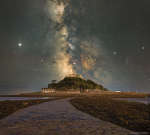 The Milky Way over St Michaels Mount
7.09.2020
Where do land and sky converge? On every horizon -- but in this case the path on the ground leads to St Michael's Mount (Cornish: Karrek Loos yn Koos), a small historic island in Cornwall, England. The Mount is usually surrounded by shallow water, but at low tide is spanned by a human-constructed causeway.
 APOD: 2023 December 19 Б NGC 1499: The California Nebula
19.12.2023
Could Queen Calafia's mythical island exist in space? Perhaps not, but by chance the outline of this molecular space cloud echoes the outline of the state of California, USA. Our Sun has its home within the Milky Way's Orion Arm, only about 1,000 light-years from the California Nebula.
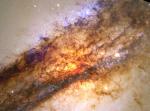 The Center of Centaurus A
21.04.2002
A fantastic jumble of young blue star clusters, gigantic glowing gas clouds, and imposing dark dust lanes surrounds the central region of the active galaxy Centaurus A. This mosaic of Hubble Space Telescope images taken in blue, green, and red light has been processed to present a natural color picture of this cosmic maelstrom.
 3D Mars: Northern Terra Meridiani
28.08.2002
In this spectacular 3D stereoscopic view from orbit, steep-sided, flat-topped hills stand above the Terra Meridiani region of Mars. Seen best with red/blue glasses (red for the left eye), the structures are reminiscent of buttes and mesas found in southwestern areas of the North American continent on planet Earth.
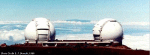 Keck: The Largest Optical Telescope
15.07.1996
In buildings eight stories tall rest mirrors ten meters across that are slowly allowing humanity to map the universe. Alone, each is the world's largest optical telescope: Keck. Together, the twin Keck telescopes have the resolving power of a single telescope 90-meter in diameter, able to discern sources just milliarcseconds apart.
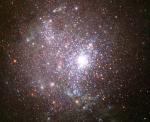 The Stars of NGC 1705
23.04.2003
Some 2,000 light-years across, NGC 1705 is small as galaxies go, similar to our Milky Way's own satellite galaxies, the Magellanic Clouds. At a much larger distance of 17 million light-years...
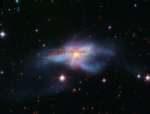 NGC 6240: Merging Galaxies
18.06.2009
NGC 6240 offers a rare glimpse of a cosmic catastrophe in its final throes. The titanic galaxy-galaxy collision is located a mere 400 million light-years away in the constellation Ophiuchus. One of the brightest...
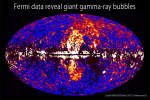 Huge Gamma Ray Bubbles Found Around Milky Way
10.11.2010
Did you know that our Milky Way Galaxy has huge bubbles emitting gamma rays from the direction of the galactic center? Neither did anybody. As the data from the Earth-orbiting Fermi satellite began acuminating over the past two years, however, a large and unusual feature toward our Galaxy's center became increasingly evident.
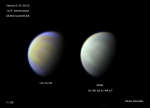 Multicolor Venus
1.03.2012
Brilliant Venus now shines in western skies at twilight. Seen as the prominent evening star, the planet is a tantalizing celestial beacon even for casual skygazers. Venus can offer less than satisfying telescopic views though. The planet is shrouded in reflective clouds that appear bright but featureless at the eyepiece.
|
January February March April May June July August September October |
|||||||||||||||||||||||||||||||||||||||||||||||||