
|
You entered: ring
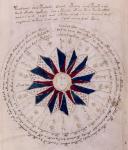 The Mysterious Voynich Manuscript
22.01.2005
The ancient text has no known title, no known author, and is written in no known language: what does it say and why does it have many astronomy illustrations? The mysterious book was once bought by an emperor, forgotten on a library shelf, sold for thousands of dollars, and later donated to Yale.
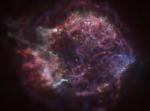 Cas A Supernova Remnant in X Rays
3.01.2000
The complex shell of a star seen to explode 300 years ago is helping astronomers to understand how that star exploded. The above recently released image of supernova remnant Cassiopeia A (Cas A) shows unprecedented detail in three X-ray colors.
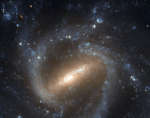 Barred Spiral Galaxy NGC 1073
20.02.2012
Many spiral galaxies have bars across their centers. Even our own Milky Way Galaxy is thought to have a modest central bar. Prominently barred spiral galaxy NGC 1073, pictured above, was captured in spectacular detail in this recently released image taken by the orbiting Hubble Space Telescope.
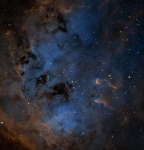 The Tadpoles of IC 410
9.01.2014
This telescopic close-up shows off the otherwise faint emission nebula IC 410 in striking false-colors. It also features two remarkable inhabitants of the cosmic pond of gas and dust below and right of center, the tadpoles of IC 410. The picture is a composite of images taken through narrow band filters.
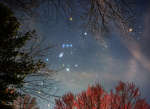 Orion Spring
25.03.2015
As spring comes to planet Earth's northern hemisphere, familiar winter constellation Orion sets in early evening skies and budding trees frame the Hunter's stars. The yellowish hue of cool red supergiant Alpha Orionis, the great star Betelgeuse, mingles with the branches at the top of this colorful skyscape.
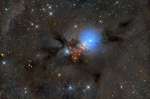 NGC 1333: Stellar Nursery in Perseus
5.11.2015
NGC 1333 is seen in visible light as a reflection nebula, dominated by bluish hues characteristic of starlight reflected by interstellar dust. A mere 1,000 light-years distant toward the heroic constellation Perseus, it lies at the edge of a large, star-forming molecular cloud.
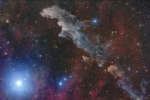 Rigel and the Witch Head Nebula
15.01.2018
By starlight this eerie visage shines in the dark, a crooked profile evoking its popular name, the Witch Head Nebula. In fact, this entrancing telescopic portrait gives the impression that the witch has fixed her gaze on Orion's bright supergiant star Rigel.
 The Day After Mars
1.11.2019
October 31, 1938 was the day after Martians encountered planet Earth, and everything was calm. Reports of the invasion were revealed to be part of a Halloween radio drama, the now famous broadcast based on H.G. Wells' scifi novel War of the Worlds.
 Iron in the Butterfly Nebula
21.07.2020
Can stars, like caterpillars, transform themselves into butterflies? No, but in the case of the Butterfly Nebula -- it sure looks like it. Though its wingspan covers over 3 light-years and its estimated surface temperature...
 APOD: 2024 March 12 Б A Galaxy Shaped Rocket Exhaust Spiral
12.03.2024
What's that over the horizon? What may look like a strangely nearby galaxy is actually a normal rocket's exhaust plume -- but unusually backlit. Although the SpaceX Falcon 9 rocket was launched from...
|
January February March April May June July August September October |
|||||||||||||||||||||||||||||||||||||||||||||||||