
|
You entered: ring
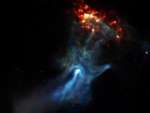 A Pulsar s Hand
1.05.2010
As far as pulsars go, PSR B1509-58 appears young. Light from the supernova explosion that gave birth to it would have first reached Earth some 1,700 years ago. The magnetized, 20 kilometer-diameter neutron star spins 7 times per second, a cosmic dynamo that powers a wind of charged particles.
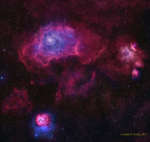 A Sagittarius Triplet
27.07.2017
These three bright nebulae are often featured on telescopic tours of the constellation Sagittarius and the crowded starfields of the central Milky Way. In fact, 18th century cosmic tourist Charles Messier cataloged two of them; M8, the large nebula above and left of center, and colorful M20 near the bottom of the frame.
 Yogi and Friends in 3D
10.05.2025
This picture from July 1997 shows a ramp from the Pathfinder lander, the Sojourner robot rover, deflated landing airbags, a couch, Barnacle Bill and Yogi Rock appear together in this 3D stereo view of the surface of Mars. Barnacle Bill is the rock just left of the house cat-sized, solar-paneled Sojourner.
 APOD: 2025 July 29 Б A Helix Nebula Deep Field
29.07.2025
Is the Helix Nebula looking at you? No, not in any biological sense, but it does look quite like an eye. The Helix Nebula is so named because it also appears that you are looking down the axis of a helix.
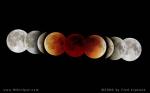 Third Millennium, First Eclipse
4.01.2001
The first eclipse of the third millennium is coming up! A total lunar eclipse mainly visible from Europe, Asia, and Africa, will occur on January 9th as the full Moon glides through the long, but not so dark shadow of planet Earth. Why not so dark?
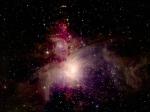 Orion Nebula: The 2MASS View
20.04.2002
Few astronomical sights excite the imagination like the nearby stellar nursery known as the Orion Nebula. The Nebula's glowing gas surrounds hot young stars at the edge of an immense interstellar molecular cloud only 1,500 light-years away.
 Neptune's Great Dark Spot: Gone But Not Forgotten
8.05.1996
When NASA's Voyager 2 spacecraft flew by distant Neptune in August of 1989, astronomers were shocked. Since Neptune receives only 3 percent the sunlight Jupiter does, they expected to find a dormant, dark, frigid planet. Instead, the Voyager images revealed evidence of a dynamic and turbulent world.
 Solstice Celebration
21.12.2002
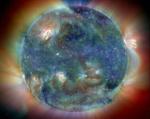
Aloha and Season's greetings! On December 22nd, at 01:14 Universal Time (December 21, 3:14pm Hawaii-Aleutian Standard Time), the Sun reaches its southernmost point in planet Earth's sky marking the final season change for the year 2002. In celebration, consider this delightfully detailed, brightly colored image of the active Sun.
 Moon Slide Slim
15.05.2003
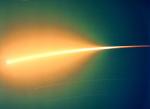
No special filters - or even a telescope - are required to enjoy a leisurely lunar eclipse. In fact, watched from all over the night side of planet Earth, these regular celestial performances have entertained many casual skygazers. Still, this eye-catching picture of a lunar eclipse may look unfamiliar.
 The Tadpoles of IC 410
11.01.2006
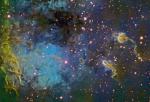
This close-up view shows a portion of otherwise faint emission nebula IC 410 in striking false-colors. It also shows two remarkable denizens of the glowing gas cloud at the right - the "tadpoles" of IC 410. The picture is a composite of images taken through narrow band filters intended to trace atoms in the nebula.
|
January February March April May June July August September October |
|||||||||||||||||||||||||||||||||||||||||||||||||