
|
You entered: ring
 Stereo Jupiter near Opposition
5.12.2024
Jupiter looks sharp in these two rooftop telescope images. Both were captured last year on November 17 from Singapore, planet Earth, about two weeks after Jupiter's 2023 opposition. Climbing high in midnight skies the giant planet was a mere 33.4 light-minutes from Singapore. That's about 4 astronomical units away.
 Hydrogen Clouds of M33
30.01.2025
Gorgeous spiral galaxy Messier 33 seems to have more than its fair share of glowing hydrogen gas. A prominent member of the local group of galaxies, M33 is also known as the Triangulum Galaxy and lies a mere 3 million light-years away.
 VDB 142 in Cepheus
11.10.2001
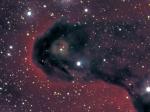
A gorgeous collection of dust and gas nebulae in the Northern Milky Way graces the high and far off constellation of Cepheus. With colors based on astronomical filters, this close up of the region highlights stars embedded in curiously shaped cosmic clouds.
 The Clouds of Neptune
7.05.1996
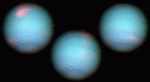
These Hubble Space Telescope (HST) images reveal glimpses of the dynamic atmosphere of Neptune, the Solar System's most distant gas giant planet. The first close-up of Neptune's clouds was provided by NASA's Voyager 2 spacecraft during its August 1989 flyby, giving a tantalizingly brief look.
 Spirit s 3D View Towards Sleep Hollow
6.01.2004
Working late, tired mission members nicknamed the smooth-looking depression to the left of center in this image from the martian surface, Sleepy Hollow. The picture is a portion of the 3D panorama of the Spirit rover's landing site released yesterday, constructed with data from the Mars rover's navigation cameras.
 Mjølnir: Impact Crater
10.06.1999
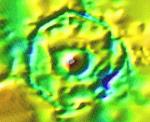
The stark surface of Earth's moon is pocked with large craters, records of a history of fierce bombardment by the solar system's formative debris. It may be difficult to imagine, but nearby planet Earth itself has endured a similar cosmic pounding, though oceans, weathering, and geological
 The Arms of NGC 4258
11.04.2007
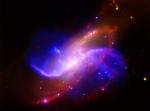
Better known as M106, bright spiral galaxy NGC 4258 is about 30 thousand light years across and 21 million light years away toward the northern constellation Canes Venatici. The yellow and red hues in this composite image show the galaxy's sweeping spiral arms as seen in visible and infrared light.
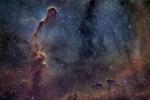 The Elephant s Trunk in IC 1396
18.10.2007
Like an illustration in a galactic Just So Story, the Elephant's Trunk Nebula winds through the emission nebula and young star cluster complex IC 1396, in the high and far off constellation of Cepheus. Of course, this cosmic elephant's trunk is over 20 light-years long.
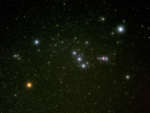 Camera Orion
15.10.2008
Orion, the Hunter, is one of the most easily recognizable constellations in planet Earth's night sky. But Orion's stars and nebulas don't look quite as colorful to the eye as they...
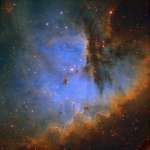 NGC 281
10.12.2008
Look through the cosmic cloud cataloged as NGC 281 and it's almost easy to miss stars of the open cluster IC 1590. But, formed within the nebula, that cluster's young, massive stars ultimately power the pervasive nebular glow.
|
January February March April May June July August September October |
|||||||||||||||||||||||||||||||||||||||||||||||||