
|
You entered: ring
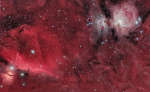 Horsehead and Orion Nebulas
5.10.2010
The dark Horsehead Nebula and the glowing Orion Nebula are contrasting cosmic vistas. Adrift 1,500 light-years away in one of the night sky's most recognizable constellations, they appear in opposite corners of the above stunning mosaic.
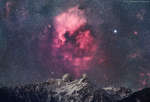 North American Nightscape
29.01.2021
On January 21, light from the Moon near first quarter illuminated the foreground in this snowy mountain and night scene. Known as The Lions, the striking pair of mountain peaks are north of Vancouver, British Colombia, Canada, North America, planet Earth.
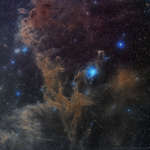 Chamaeleon Dark Nebulas
17.01.2022
Sometimes the dark dust of interstellar space has an angular elegance. Such is the case toward the far-south constellation of Chamaeleon. Normally too faint to see, dark dust is best known for blocking visible light from stars and galaxies behind it.
 APOD: 2023 April 25 Б Northern Lights over Southern Europe
25.04.2023
Did you see an aurora over the past two nights? Many people who don't live in Earth's far north did. Reports of aurora came in not only from northern locales in the USA as Alaska, but as far south as Texas and Arizona. A huge auroral oval extended over Europe and Asia, too.
 Mu Cephei
12.10.2023
Mu Cephei is a very large star. An M-class supergiant some 1500 times the size of the Sun, it is one of the largest stars visible to the unaided eye, and even one of the largest in the entire Galaxy.
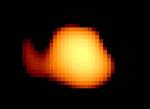 Resolving Mira
11.10.1998
Most stars appear only as points of light. Early last year, Betelgeuse became the second star, after our Sun, to have it surface resolved. Later last year, Mira was added to the list. Mira...
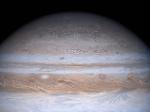 Jupiters Clouds from Cassini
11.09.2005
Gas giant Jupiter is the solar system's largest world with about 320 times the mass of planet Earth. Famous for its Great Red Spot, Jupiter is also known for its regular, equatorial cloud bands, visible in very modest sized telescopes.
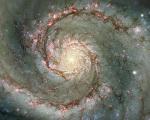 M51: The Whirlpool Galaxy in Dust and Stars
19.02.2006
The Whirlpool Galaxy is a classic spiral galaxy. At only 30 million light years distant and fully 60 thousand light years across, M51, also known as NGC 5194, is one of the brightest and most picturesque galaxies on the sky.
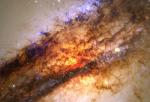 The Center of Centaurus A
22.08.1999
A fantastic jumble of young blue star clusters, gigantic glowing gas clouds, and imposing dark dust lanes surrounds the central region of the active galaxy Centaurus A. This mosaic of Hubble Space Telescope images taken in blue, green, and red light has been processed to present a natural color picture of this cosmic maelstrom.
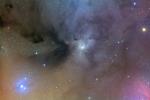 IC 4603: Reflection Nebula in Ophiuchius
4.06.2007
Why does this starfield photograph resemble an impressionistic painting? The effect is created not by digital trickery but by large amounts of interstellar dust. Dust, minute globs rich in carbon and similar in size to cigarette smoke, frequently starts in the outer atmospheres of large, cool, young stars.
|
January February March April May June July August September October |
|||||||||||||||||||||||||||||||||||||||||||||||||