
|
You entered: image
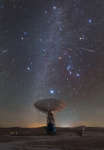 Geminids of the North
15.12.2017
Earth's annual Geminid meteor shower did not disappoint as our fair planet plowed through dust from active asteroid 3200 Phaethon. Captured in this northern hemisphere nightscape, the meteors stream away from the shower's radiant in Gemini.
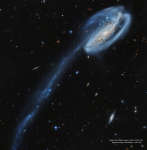 Arp 188 and the Tadpole's Tail
11.12.2018
Why does this galaxy have such a long tail? In this stunning vista, based on image data from the Hubble Legacy Archive, distant galaxies form a dramatic backdrop for disrupted spiral galaxy Arp 188, the Tadpole Galaxy. The cosmic tadpole is a mere 420 million light-years distant toward the northern constellation of the Dragon (Draco).
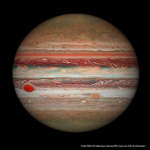 Hubbles Jupiter and the Shrinking Great Red Spot
9.01.2022
What will become of Jupiter's Great Red Spot? Gas giant Jupiter is the solar system's largest world with about 320 times the mass of planet Earth. Jupiter is home to one of the largest and longest lasting storm systems known, the Great Red Spot (GRS), visible to the left.
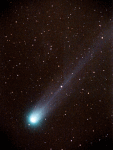 What are Comet Tails Made Of?
26.03.1996
The tail of comet Hyakutake, visible in this recent color image, is composed of dust and gas driven off the icy comet nucleus by the Sun's heat and blown away by the solar wind. Bathed in solar ultraviolet light, the gas molecules break down and are excited, producing a characteristic glow.
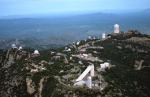 Kitt Peak National Observatory
18.01.1999
At the top of Kitt Peak Mountain near Tucson, Arizona lies one of the world's great collections of telescopes. As pictured, in the dome at the far left lies the 3.5-meter WIYN Telescope, famous recently for tracking distant supernovae.
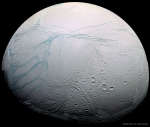 Fresh Tiger Stripes on Saturns Enceladus
27.04.2020
How will humanity first learn of extraterrestrial life? One possibility is to find it under the icy surface of Saturn's moon Enceladus. A reason to think that life may exist there are long features -- dubbed tiger stripes -- that are known to be spewing ice from the moon's icy interior into space.
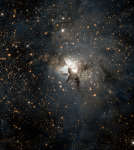 Central Lagoon in Infrared
19.03.2021
Stars fill this infrared view, spanning 4 light-years across the center of the Lagoon Nebula. Visible light images show the glowing gas and obscuring dust clouds that dominate the scene. But this infrared image...
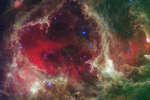 W5: Pillars of Star Formation
20.11.2011
How do stars form? A study of star forming region W5 by the sun-orbiting Spitzer Space Telescope provides clear clues by recording that massive stars near the center of empty cavities are older than stars near the edges.
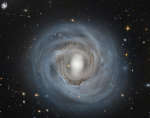 Anemic Spiral NGC 4921 from Hubble
25.11.2013
How far away is spiral galaxy NGC 4921? Although presently estimated to be about 310 million light years distant, a more precise determination could be coupled with its known recession speed to help humanity better calibrate the expansion rate of the entire visible universe.
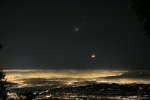 A Happy Sky over Los Angeles
12.11.2017
Sometimes, the sky may seem to smile over much of planet Earth. On this day in 2008, visible the world over, was an unusual superposition of our Moon and the planets Venus and Jupiter.
|
January February March April May June July August September |
|||||||||||||||||||||||||||||||||||||||||||||||||