
|
You entered: image
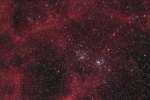 Double Cluster in Perseus
23.01.2014
This lovely starfield spans some seven full moons (about 3.5 degrees) across the heroic northern constellation of Perseus. Just right of center it holds the famous pair of open or galactic star clusters, h and Chi Perseii.
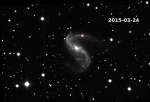 The Rise and Fall of Supernova 2015F
8.02.2016
Sit back and watch a star explode. The actual supernova occurred back when dinosaurs roamed the Earth, but images of the spectacular event began arriving last year. Supernova 2015F was discovered in nearby spiral...
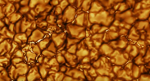 Solar Granules at Record High Resolution
2.02.2020
Why does the Sun's surface keep changing? The help find out, the US National Science Foundation (NSF) has built the Daniel K. Inouye Solar Telescope in Hawaii, USA. The Inouye telescope...
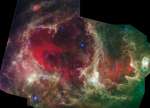 Generations of Stars in W5
29.08.2008
Giant star forming region W5 is over 200 light-years across and about 6,500 light-years away in the constellation Cassiopeia. W5's sculpted clouds of cold gas and dust seem to form fantastic shapes in this impressive mosaic of infrared images from the Spitzer Space Telescope.
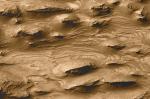 Layered Mars: An Ancient Water World
4.12.2000
Pictured above, layers upon layers stretch across the floor of West Candor Chasma within the immense martian Valles Marineris. Covering an area 1.5 by 2.9 kilometers, the full image from the Mars Global Surveyor spacecraft shows over 100 individual beds.
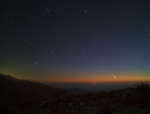 Comets Lemmon and PanSTARRS Peaking
5.03.2013
Two impressive comets will both reach their peak brightness during the next two weeks. Taking advantage of a rare imaging opportunity, both of these comets were captured in the sky together last week over the Atacama desert in South America.
 Mars in the Loop
29.05.2025
This composite of images spaced a weather-permitting 5 to 9 days apart, from 2024 September 19 (top right) through 2025 May 18 (bottom left), faithfully traces ruddy-colored Mars as it makes a clockwise loop through the constellations Gemini and Cancer in planet Earth's night sky.
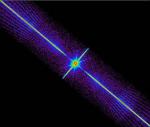 X Ray Rainbows
11.05.2001
A drop of water or prism of glass can spread out visible sunlight into a rainbow of colors. In order of increasing energy, the well known spectrum of colors in a rainbow runs red, orange, yellow, green, blue, indigo, violet.
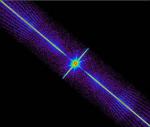 X Ray Rainbows
28.09.2002
A drop of water or prism of glass can spread out visible sunlight into a rainbow of colors. In order of increasing energy, the well known spectrum of colors in a rainbow runs red, orange, yellow, green, blue, indigo, violet.
 Small Star
5.06.1997
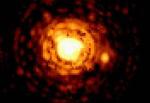
A dim double star system cataloged as Gliese 623 lies 25 light-years from Earth, in the constellation of Hercules. The individual stars of this binary system were distinguished for the first time when the Hubble Space Telescope's Faint Object Camera recorded this image in June 1994.
|
January February March April May June July August September |
|||||||||||||||||||||||||||||||||||||||||||||||||