
|
You entered: image
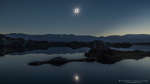 A Total Solar Eclipse Reflected
5.08.2019
If you saw a total solar eclipse, would you do a double-take? One astrophotographer did just that -- but it took a lake and a bit of planning. Realizing that the eclipse would...
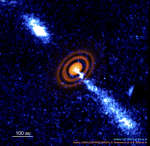 HD 163296: Jet from a Star in Formation
22.06.2021
How are jets created during star formation? No one is sure, although recent images of the young star system HD 163296 are quite illuminating. The central star in the featured image is still forming but seen already surrounded by a rotating disk and an outward moving jet.
 NGC 6164: A Dragon s Egg
24.04.2025
Beautiful emission nebula NGC 6164 was created by a rare, hot, luminous O-type star, some 40 times as massive as the Sun. Seen at the center of the cosmic cloud, the star is a mere 3 to 4 million years old.
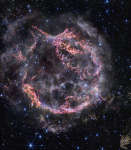 Supernova Remnant Cassiopeia A
6.02.2026
Massive stars in our Milky Way Galaxy live spectacular lives. Collapsing from vast cosmic clouds, their nuclear furnaces ignite and create heavy elements in their cores. After only a few million years for the most massive stars, the enriched material is blasted back into interstellar space where star formation can begin anew.
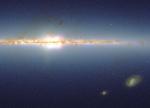 Counting Stars in the Infrared Sky
19.07.2002
The bulging center of our Milky Way Galaxy, dark cosmic clouds, the thin galactic plane, and even nearby galaxies are easy to spot in this sky view. But each pixel in the digital image is actually based on star counts alone -- as derived from the Two Micron All Sky Survey (2MASS) database.
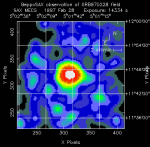 Gamma-Ray Burster
19.03.1997
What and where are the Gamma-Ray Bursters? Since their discovery in the early 1970s, nobody has been able to explain the cause of mysterious flashes of gamma rays that come from seemingly random directions on the sky.
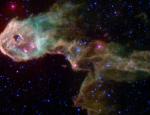 Inside The Elephant s Trunk
19.12.2003
Spectacular first images from the newly christened Spitzer Space Telescope include this penetrating interior view of an otherwise opaque dark globule known as the Elephant's Trunk Nebula. Seen in a composite of infrared...
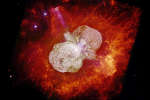 APOD: 2008 June 17- Eta Carinae and the Homunculus Nebula
17.06.2008
How did the star Eta Carinae create this unusual nebula? No one knows for sure. About 165 years ago, the southern star Eta Carinae mysteriously became the second brightest star in the night sky. In 20 years, after ejecting more mass than our Sun, Eta Car unexpected faded.
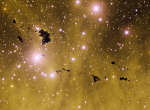 Thackerays Globules
12.06.2012
These are larger dust bunnies than you will find under your bed. Situated in rich star fields and glowing hydrogen gas, these opaque clouds of interstellar dust and gas are so large they might be able to form stars.
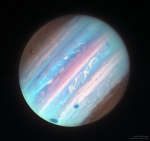 APOD: 2025 November 11 Б Jupiter in Ultraviolet from Hubble
11.11.2025
Jupiter looks a bit different in ultraviolet light. To better interpret Jupiter's cloud motions and to help NASA's robotic Juno spacecraft understand the planetary context of the small fields that it sees, the Hubble Space Telescope was being directed to regularly image the entire Jovian giant.
|
January February March April May June July August September |
|||||||||||||||||||||||||||||||||||||||||||||||||