
|
You entered: image
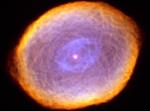 IC 418: The Spirograph Nebula
7.09.2000
What is creating the strange texture of IC 418? Dubbed the Spirograph Nebula for its resemblance to drawings from a cyclical drawing tool, planetary nebula IC 418 shows patterns that are not well understood. Perhaps they are related to chaotic winds from the variable central star, which changes brightness unpredictably in just a few hours.
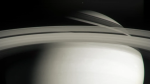 Views from Cassini at Saturn
13.06.2011
What has the Cassini orbiter seen since arriving at Saturn? The above music video shows some of the highlights. In the first time-lapse sequence (00:07), a vertical line appears that is really Saturn's thin rings seen nearly edge-on. Soon some of Saturn's moon shoot past.
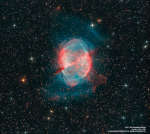 M27: Not a Comet
20.08.2015
While hunting for comets in the skies above 18th century France, astronomer Charles Messier diligently kept a list of the things he encountered that were definitely not comets. This is number 27 on his now famous not-a-comet list.
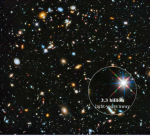 The Hubble Ultra Deep Field in Light and Sound
2.08.2021
Have you heard about the Hubble Ultra-Deep Field? Either way, you've likely not heard about it like this -- please run your cursor over the featured image and listen! The Hubble Ultra-Deep Field (HUDF)...
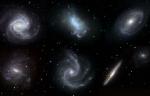 Visitors Galaxy Gallery
18.06.2005
A tantalizing assortment of island universes is assembled here. From top left to bottom right are the lovely but distant galaxies M61, NGC 4449, NGC 4725, NGC 5068, NGC 5247, and NGC 5775/5774. Most are spiral galaxies more or less like our own Milky Way.
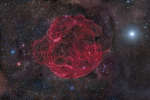 Simeis 147: Supernova Remnant
9.10.2012
It's easy to get lost following the intricate filaments in this detailed mosaic image of faint supernova remnant Simeis 147 (S147). Also cataloged as Sh2-240, it covers nearly 3 degrees or 6 full moons on the sky. That's about 150 light-years at the stellar debris cloud's estimated distance of 3,000 light-years.
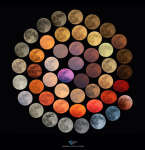 Colors of the Moon
15.05.2022
What color is the Moon? It depends on the night. Outside of the Earth's atmosphere, the dark Moon, which shines by reflected sunlight, appears a magnificently brown-tinged gray. Viewed from inside the Earth's atmosphere, though, the moon can appear quite different.
 APOD: 2024 January 7 Б The Cats Eye Nebula in Optical and X-ray
7.01.2024
To some it looks like a cat's eye. To others, perhaps like a giant cosmic conch shell. It is actually one of the brightest and most highly detailed planetary nebula known, composed of gas expelled in the brief yet glorious phase near the end of life of a Sun-like star.
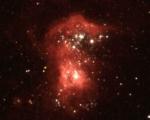 Bright Stars, Dim Galaxy
3.11.2001
These two clusters of bright, newly formed stars surrounded by a glowing nebula lie 10 million light-years away in the dim, irregular galaxy cataloged as NGC 2366. The Hubble Space Telescope image shows that...
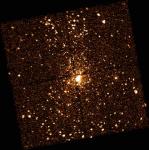 X-Ray Stars Of Orion
4.02.2000
The stars of Orion shine brightly in northern winter skies where the constellation harbors the closest large stellar nursery, the Great Nebula of Orion, a mere 1500 light-years away. In fact, the apparently bright...
|
January February March April May June July August September |
|||||||||||||||||||||||||||||||||||||||||||||||||