
|
You entered: telescope
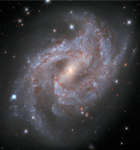 Supernova in NGC 2525
23.10.2020
Big, beautiful, barred spiral galaxy NGC 2525 lies 70 million light-years from the Milky Way. It shines in Earth's night sky within the boundaries of the southern constellation Puppis. About 60,000 light-years...
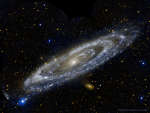 The Andromeda Galaxy in Ultraviolet
18.07.2021
What does the Andromeda galaxy look like in ultraviolet light? Young blue stars circling the galactic center dominate. A mere 2.5 million light-years away, the Andromeda Galaxy, also known as M31, really is just next door as large galaxies go.
 APOD: 2024 May 8 Б Visualization: A Black Hole Accretion Disk
8.05.2024
What would it look like to circle a black hole? If the black hole was surrounded by a swirling disk of glowing and accreting gas, then the great gravity of the black hole would deflect light emitted by the disk to make it look very unusual. The featured animated video gives a visualization.
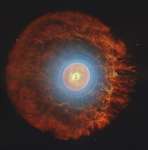 APOD: 2026 June 4 Б A Planetary Nebula with Cosmic Buckyballs
4.06.2026
What is happening inside this unusual nebula? Planetary nebula Tc 1, captured here in exquisite detail by the James Webb Space Telescope, is the celestial site where buckyballs were first identified in 2010. Buckminsterfullerene...
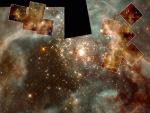 Massive Stars of 30 Doradus
22.06.2003
In the center of star-forming region 30 Doradus lies a huge cluster of the largest, hottest, most massive stars known. These stars and part of the surrounding nebula are captured here in this gorgeous visible-light Hubble Space Telescope image.
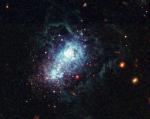 I Zwicky 18: Young Galaxy
3.12.2004
The Milky Way is an ordinary 12 billion year old spiral galaxy, and even our middle-aged Sun is pushing 4.5 billion years. But all the stars in dwarf galaxy I Zwicky 18 are much younger.
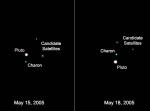 Possible Pluto Moons
3.11.2005
In 1930, tiny, icy world Pluto was discovered orbiting in the distant solar system. In 1978, its relatively large companion Charon was detected by ground-based observations. This year, the Hubble Space Telescope may well have detected two further members of the Pluto system.
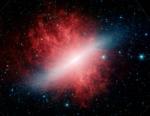 Smoke from the Cigar Galaxy
14.04.2006
Very bright in infrared light, well-known starburst galaxy M82's popular name describes its suggestive shape seen at visible wavelengths - The Cigar Galaxy. Ironically, M82's fantastic appearance in this Spitzer Space Telescope image...
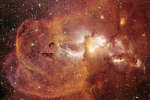 Star Forming Region NGC 3582
28.04.2008
What's happening in the NGC 3582 nebula? Bright stars and interesting molecules are forming. The complex nebula resides in the star forming region called RCW 57. Visible in this image are dense knots...
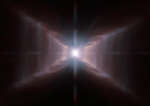 The Red Rectangle Nebula from Hubble
14.06.2010
How was the unusual Red Rectangle nebula created? At the nebula's center is a young binary star system that surely powers the nebula but does not, as yet, explain its colors. The unusual...
|
January February March April May June July August September October |
|||||||||||||||||||||||||||||||||||||||||||||||||