
|
You entered: constellation
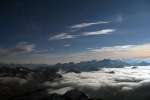 Pyrenees Paraselene
11.06.2009
A sea of clouds laps at rugged moutain peaks of the French Pyrenees in this serene view from Pic du Midi Observatory. The time exposure was recorded on June 4, with the constellations Sagittarius and Scorpius shining in the starry night. At the top right lies a faint, but colorful moondog or paraselene.
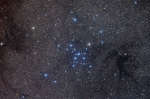 M7: Open Star Cluster in Scorpius
12.09.2012
M7 is one of the most prominent open clusters of stars on the sky. The cluster, dominated by bright blue stars, can be seen with the naked eye in a dark sky in the tail of the constellation of the Scorpion (Scorpius).
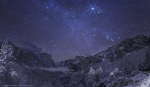 Yosemite Winter Night
25.12.2012
In this evocative night skyscape a starry band of the Milky Way climbs over Yosemite Valley, Sierra Nevada Range, planet Earth. Jupiter is the brightest celestial beacon on the wintry scene, though. Standing nearly opposite the Sun in the constellation Taurus, the wandering planet joins yellowish Aldebaran and the Hyades star cluster.
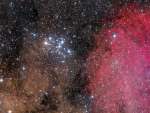 M6: The Butterfly Cluster
3.09.2014
To some, the outline of the open cluster of stars M6 resembles a butterfly. M6, also known as NGC 6405, spans about 20 light-years and lies about 2,000 light years distant. M6, pictured...
 Near the Center of the Lagoon Nebula
4.11.2019
Stars are battling gas and dust in the Lagoon Nebula but the photographers are winning. Also known as M8, this photogenic nebula is visible even without binoculars towards the constellation of the Archer (Sagittarius). The energetic processes of star formation create not only the colors but the chaos.
 Lyrid of the Lake
28.04.2022
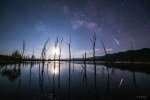
In the early hours of April 24 this bright Lyrid meteor flashed along the central Milky Way. For a moment, it cast a bright reflection across Lake Nian, Yunnan province, China. The annual Lyrid...
 M1: The Crab Nebula
25.07.1995
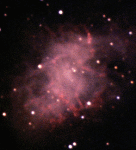
In the year 1054 a star in the constellation of Taurus exploded in a spectacular supernova so bright it appeared to dominate the sky except for the Sun and Moon for many days. It left behind one of the most brilliant nebulae, listed first in Charles Messier's list of nebulous sky objects.
 Stars and Planets in the Halo of the Moon
21.03.2003
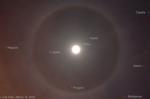
Photographed on March 13th from Caledon, Ontario, Canada, a bright Moon was surrounded by this lovely halo. Planet Jupiter and stars Procyon, Castor, and Pollux also appear within the circle of lunar light. Castor...
 M13: The Great Globular Cluster in Hercules
1.03.2000
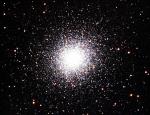
M13 is one of the most prominent and best known globular clusters. Visible with binoculars in the constellation of Hercules, M13 is frequently one of the first objects found by curious sky gazers seeking celestials wonders beyond normal human vision.
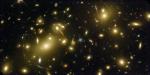 Abell 2218: A Galaxy Cluster Lens
1.02.2000
Gravity can bend light. Almost all of the bright objects in this recently released Hubble Space Telescope image are galaxies in the cluster known as Abell 2218. The cluster is so massive and so compact that its gravity bends and focuses the light from galaxies that lie behind it.
|
January February March April May June July August September October |
|||||||||||||||||||||||||||||||||||||||||||||||||