
|
You entered: constellation
 NGC 289: Swirl in the Southern Sky
15.10.2021
About 70 million light-years distant, gorgeous spiral galaxy NGC 289 is larger than our own Milky Way. Seen nearly face-on, its bright core and colorful central disk give way to remarkably faint, bluish spiral arms. The extensive arms sweep well over 100 thousand light-years from the galaxy's center.
 The Deep Lagoon
28.09.2023
Ridges of glowing interstellar gas and dark dust clouds inhabit the turbulent, cosmic depths of the Lagoon Nebula. Also known as M8, The bright star forming region is about 5,000 light-years distant. It makes for a popular stop on telescopic tours of the constellation Sagittarius toward the center of our Milky Way Galaxy.
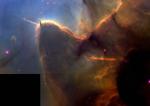 Starbirth in the Trifid Nebula
7.06.1999
Tremendous pillars of gas and dust are being boiled away in the Trifid Nebula. In the center of the picturesque Trifid lies a young hot star, located above and to the right of this picture. As soon as it was born, the massive star scorched its surroundings with bright and
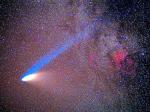 Comet Hale Bopp and the North America Nebula
3.10.2004
Comet Hale-Bopp's 1997 encounter with the inner Solar System allowed many breath-taking pictures. Above, Comet Hale-Bopp was photographed crossing the constellation of Cygnus, sporting spectacular yellow dust and blue ion tails. Visible on the right in red is the North America Nebula, a bright emission nebula observable from a dark location with binoculars.
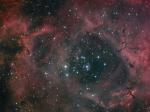 Dust and Light in the Rosette Nebula
14.02.2006
What creates the cosmic dust sculptures in the Rosette Nebula? Noted for the common beauty of its overall shape, parts of the Rosette Nebula, also known as NGC 2244, show beauty even when viewed up close.
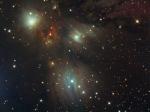 Still Life with NGC 2170
5.08.2006
In this beautiful celestial still life composed with a cosmic brush, dusty nebula NGC 2170 shines at the upper left. Reflecting the light of nearby hot stars, NGC 2170 is joined by other bluish reflection nebulae and a compact red emission region against a backdrop of stars.
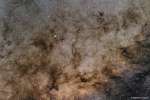 Stars and Dust through Baade s Window
19.12.2007
Billions of stars light up the direction toward the center of our Galaxy. The vast majority of these stars are themselves billions of years old, rivaling their home Milky Way Galaxy in age. Together with interstellar dust, these old stars combine to create this yellowish starscape.
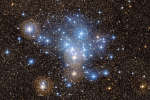 Open Cluster M25
31.08.2009
Many stars like our Sun were formed in open clusters. The above pictured open cluster, M25, contains thousands of stars and is about two thousand light years distant. The stars in this cluster all formed together about 90 million years ago. The bright young stars in M25 appear blue.
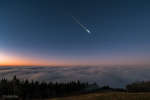 Good Morning Leonid
23.11.2018
On November 17, just an hour before sunrise, this bright and colorful meteor flashed through clear predawn skies. Above a sea of clouds this striking autumn morning's moment was captured from Hochblauen, a prominent 1165 meter high summit in southern Germany's Black Forest.
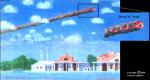 A Daytime Fireball in 1944
16.11.2000
While stationed in central Africa in December 1944, Norman Appleton witnessed a meteor so bright he remembered it his entire life. Right before his eyes a tremendous smoking fireball streaked across the daytime sky. Years later, as an accomplished member of the Guild of Aviation Artists, he recorded his memories in the above painting.
|
January February March April May June July August September October |
|||||||||||||||||||||||||||||||||||||||||||||||||